

The Proof Of The Pudding

Somehow I missed the usual social media ruckus around St Patrick’s Day this year. I’m not entirely sure how, as it wasn’t intentional. But somehow I did.

(Algorithms. It was probably the algorithms.)

A week-or-so later though, my feed was full of it. All the same arguments, all the same misconceptions recycled from year-to-year. And of course, I also saw the same people valiantly wading in to stem the tide of bad information.

You know, the usual story.

Arguing about this stuff seems to have become something of a tradition nowadays, and an unwanted one at that. Once upon a time, I would have been out there as well, but nowadays I’m just glad to have missed the whole thing. (If only the same were true for Ostara!)

You see, one thing I’ve realized over the years is that these arguments really aren’t about the topic at hand for the most part. In my experience, they’re usually about something much deeper. And until we address that something, no amount of good information is going to turn back that tide.

Conversion

As I explained in this previous post, facts and logic do poorly against narrative. Unlike data, story is an immersive experience that speaks to both the heart and the mind. A well-crafted story can summon tears and devastation, affection or hatred for protagonists, exultation and joy. But if we’re not careful, a story can become bandaid for whatever bits of brokenness or lack we perceive in our lives and selves. Other times, stories can function as narrative bridges between our areas of perceived lack and what we think we need to feel whole. I have no way to prove this, of course. But I suspect that this is what underlies much of the modern Pagan/Heathen tendency to cling to inaccurate narratives.

Nowadays, religious conversion is mostly thought of as a ritual. Depending on the faith or denomination in question, there may be some training beforehand. But even in those instances, it’s still the ritual that makes the convert. A few words and a Jesus-powered supersoaker to the face (or whatever), and boom, you’re saved!

Sounds simple, right?

If only! Unfortunately, that blessed bukkake is really just the beginning of a constant and unending process. Real talk, but pretty much none of us—even those of us who’ve been doing this for decades—will develop a truly Pagan/Heathen worldview within our own lifetimes. That’s not just me being negative, it’s the truth. In this case though, I think it’s pretty freeing.

Believe it or not, but it took the early English church centuries to fully stamp out the Heathen worldview among their people. Conversion wasn’t just a case of some monks rolling up, selling people some Jesus, and everything falling into place. Christianity was largely an alien worldview to them. All of which meant the church first had to build entire conceptual frameworks to fully transition their flocks to their new faith.

So, why would we expect it to be any different for us now? If anything, I would argue our path is much harder after a millennia-and-a-half of Christianity shaping our cultural default. (And yes, that includes the parts we consider “secular” as well.)

Conversion: Hard Mode

Those aforementioned challenges aside though, the early English church had something we don’t—something that gave them a serious advantage.

They had the support of a religious institution with at least a few centuries already under its belt.

It’s never easy stepping onto a new path, but it’s much harder when that path is either doesn’t exist or is mostly buried under dirt. There’s a saying that the difference between dialect and language is an army and navy. I think we can apply a similar framework here too.

So, what is the difference between a religion with roots and whatever “dialect” we have? Well, fully developed systems of support and institutional control, for a start. Clear boundaries that—yes, contain—but also comfort and convey a feeling of certainty to those on the inside.

A Catholic (for example) never has to worry about whether they’re “doing it right” or the veracity of a saint’s hagiography. Not only do they have religious training in the form of catechism classes, they have various flavors of clergy to guide them as well. Their religion boasts entire toolboxes of responses to the uncertainties of life. Set prayers and rituals, a constellation of saints for whatever the need, and the many benefits that come with a somatic practice like praying with beads. Finally, they have the comfort of belonging to a tradition that stretches through time, and the sense of security that can bring.  (#NotAllCatholics)

And as long as they stay within the boundaries delineated by their church, they never need to worry they’re doing it wrong, or whether what they’re doing is even <em>real</em>. And why would they? The Roman church is old as shit. And as we all know (heavy sarcasm here) age always confers legitimacy.

Now, consider our own traditions, practices, and communities for a moment—our various toolboxes for this journey through life. What do we have, and what do we lack? All things considered, I think it’s hardly surprising that so many of us cling to false narratives and dream up links to ancient traditions. Belonging, security, and connection are after all core human needs.

Walking A Path With No Path

Another story now.

I’m old enough to remember when Triumph of the Moon by Professor Ronald Hutton made its way into the world. I’ve never been Wiccan in the modern sense (the OG definition though, is another matter). But I can only imagine how it must have felt for those who were at the time. Here was this scholar disproving the foundational lore of their tradition—lore that had no doubt gave many of them that sense of belonging and connection to older roots. (With all the security and legitimacy that apparently implies).

I could go on about the downstream effects of this shift, but that would be one hell of a digression. More to the point though, it would also likely lead back to arguments surrounding historicity and legitimacy when I think we’d really be better off looking for the proof in the pudding instead.

Where I’m from, any dessert can be “pudding,” therefore I dedicate this spot to a piece of lemon pound cake.

You probably already know the old saying that “The proof of the pudding is in the eating.” Simply put, you have to try something to know its flavor or worth. Is it good? Bad? Does it belong in the bin, or can it be saved? This is what I’ll be referring to as “pudding proof,” from here on out.

Now obviously, Hutton’s Triumph of the Moon didn’t break Wicca. Like I said, I’ve never been that kind of Wiccan myself, but I suspect there was enough pudding-proof to sustain the tradition regardless. In other words, the pudding proved good enough in the eating to keep making it.

Hooray for that Wicca-pud!

But what do I mean by “pudding” in this context? Well, it’s your rituals, workings, and practices. But more importantly, it’s the results and experiences you get from them.

Sir, Your Pudding Is Lacking!

Now, that may sound like “hopium,” but really it’s not. Once upon a time, even the Roman church was new. Their path wasn’t just wrecked or hidden, they were cutting it as they went. Christianity was far from the “full-service” religion it is now.

The Pagan shrines and temples on the other hand were community hubs, offering services like healing, oracular wisdom, dream incubation, and divination by lots. They were places of poetry and music, drama and dance, art, sculpture, and rhetoric (MacCullen, p. 150-159).

So you know, pretty neat places to hang out.

The cults the early Christians left had centuries-old rituals, entire languages of symbolism and ritual gestures. They had play, dance, and celebration—all of which were missing from the new Christian faith.

Hell, they weren’t even supposed to light candles in their churches unless they needed light!

“We do not light candles, as you vainly and untruly allege, in the daytime but only to lessen the darkness of the light. And bear in mind that we are not born Christians, but reborn: and because we once worshipped idols, are we now not to worship God? —lest we appear to venerate him with the same honors accorded to idols?”

Jerome to Vigilantius, 4th/5th century (MacCullen. P. 116)

Even something as foundational as prayer was an unknown language to them. They knew how to address the older divinities through speech, song, sacrifice, and dance, but their new god was entirely another matter (MacCullen. 150-159). The line between piety and idolatry was still taking shape.

But do you see what I mean? The early Christians were once where we are now (albeit traveling in the opposite direction). They, too, felt gaps in their new faith—areas of lack that sent many-a-convert back to their local Kalends and New Year’s celebrations (Ibid).

The question now then is what kept them on their new path? Obviously, the threat of persecution would come to play its part, as would the eventual transition to a “full-service” religion. But what about for those who were Christian before they won an emperor to their faith?

On Pudding Proof

Well, this is where that “pudding proof” I mentioned earlier comes in.

Again much like us, the early Christians couldn’t exactly make appeals to history or tradition. They would have been sitting on a throne of lies and they knew it. So how does a religious new kid on the block attract converts and keep them?

They focus on who is right, on whose god is a true god as opposed to a demon.

In other words, the early Christian case for conversion hinged on proving their “pudding” was good (MacCullen. p.11-12).

The Demon In The Martyr’s Pudding

According to Peter Dendle in Demon Possession In Anglo-Saxon England, exorcism was one of the main “selling points of early Christian evangelism.” Yup, much like today, turfing out demons was one of their main (if not the) kinds of pudding. A point the 2nd century bishop Irenaeus also acknowledged (Dendle. p. 54).

Now curiously, tales of demonic possession and exorcism are arguably absent from in Greco-Roman sources prior to the first and second centuries (Dendle. pp.52-53). That’s not to say that there weren’t any, of course. But the earlier references that do possibly exist are hotly debated by scholars.

The first clear example of possession and exorcism in Pagan literature appears in a 2nd century account of a Syrian exorcist from Palestine, suggesting these beliefs had their origin in the near east (Ibid). That may seem a leap until we consider the writings of the second century philosopher Plutarch. Not only did he feel the need to interrogate the origins of such beliefs, implying a lack of familiarity with them on his part, he presumed a non-Greek origin from the start (Ibid).

Weird, that!

It kind of reminds me of how the possession and exorcism narratives in early English sources were all written between the 670s and early 700s (Dendle. p.170). Though there are some later mentions, they are only ever in passing—usually while referring to a saint. A far cry from the dramatic tales of those earlier times. I’m sure that Pagan resurgence post the plague of 664 was also just a coincidence—just like that suppression campaign by the Christian kings beginning around 650 (Dendle. Pp. 146-148). Probably all just coincidence.

Right? All I’m saying is it just seems a bit convenient, you know?

Well anyway, back to those early Greco-Roman Christians. You see, not only were they slinging this (probably) new-to-their-target-audience kind of “pudding.” They marketed themselves as the best demon-pudding slingers to boot. According to the second century martyr known as Justin, Christian exorcism was the only kind that always workedeven when the possessed person was a Pagan. While he conceded that exorcisms done in the name of Abraham/Isaac/Jacob/God might sometimes work, only those done in Jesus’ name were certain of success (Dendle. p. 54).
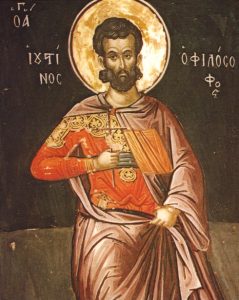
“Just Justin!”

The demon, the mark, and the audacity of that zealot, amirite?

Ironically, Justin went on to literally lose his head for the crime of impiety. As someone who refused to offer to the gods, he was considered an atheist. After all, that Pax Deorum (“peace of the gods”) wasn’t going to do a Pax Romana (“peace of Rome”) without some offerings greasing the wheels (Kirsch. pp. 108-109). From the perspective of Roman society, the dude was falling short of his civic duty, so it was off to the forever box with him. (Click here for an account of his trial.) 

“Oh, miserable men! If you wish to die, you have precipices or halters.” 

Roman proconsul stuck dealing with people like Justin.

Sourcing, Tweaking, And Tossing Pagan Pudding

But what about our Pagan Pudding? We already have quite a lot (some of it actually good), but something tells me the recipe isn’t quite there for a lot of us. So, what now?

Nowadays, we have an entire genre of horror linking Christianity with possession and exorcism narratives. The early Christians though, were far from the first demonologists. People in the ancient near east had been casting out demons for millennia before the advent of Christianity. I mean, the ritual technology of exorcism was first attested in Sumer from around 2500 BCE (Dendle. P. 42).  Borrowing has long been a source of “pudding,” and frankly the same can be said for just making shit up. How many of those early exorcism narratives do you think were true, and how many were bullshit? Given the convenient dating of those narratives, I’d say the answer to the latter part of that question was “a lot.”

Having said that, there can be a fine line between invention and inspiration, especially when we walk that line in a playful manner. Play often makes doorways for true inspiration where it would otherwise struggle to slip in. We should lean into it! It also needs to be said that there’s nothing inherently wrong with outright making shit up either. Read up on basic ritual structure and magic, and you can make some really excellent pudding! We just need to be honest about what we’re doing.

For me personally though, the rubber really meets the road when working in collaboration with the Dead, Divine, and Otherworldly. Over the years, I’ve been lucky to have teachers in each group and have received some absolute gold from all three. Pretty much all of my experimentation revolves around inviting that collaboration, deepening those connections, and finding ways to intensify my experiences. I may jokingly refer to it as “magical FAFO”, but in truth, it’s the work of relationship and revival. A sacred thing.

No matter the source of our “pudding,” however, we do have to actually give it a try once made. This may seem obvious, but since becoming an author, I’ve had more than a few folks express genuine surprise that I test everything I put out into the world.  So clearly, the expectation of testing isn’t universal when it really should be.

Another important point: we need to be honest about our results, even if only to ourselves. Here I’m reminded of the saying that “tradition is not the adoration of ashes, but the preservation of fire.” Now, this may just be me, but I feel like a lot of us have piles of ashes we should really toss out. And yes, that does also apply to the practices and rituals we perceive to be more historically accurate (ergo “legitimate”) too. If it ain’t working, it ain’t working. Sometimes we may tweak and find an ember to kindle; other times though, they’re just plain dead. (Assuming they even worked in the first place.) Either way, we need to be clear-sighted about what we have and to act accordingly. All these piles of dead ashes do for us in the end is waste our time and take up space.

Perceptions Of Worship

Equally important to consider is how our former religions have shaped and continue to shape our understanding of worship, for that, too, influences the pudding we make. For the Pagan of Rome “joy was worship,” to quote Ramsey MacMullen. ”At the Kalends or Attis day as at Easter, it was an offering of faith to show one’s happiness” (MacMullen. p. 109).

Now ask yourself, when was the last time you felt true joy in your worship? What about love? When was the last time you sang to your Holies, danced, played an instrument in their honor, or engaged in sacred play? More importantly, how do you feel when you think about those things?
What feels “allowed” or “proper” to you within the context of worship, and what feels “taboo”?

Because I suspect a lot of us are still closing ourselves off to some degree, perhaps giving ourselves over to instinct and inspiration only rarely. While I believe my holy powers are patient and fully understand that humans now are not as they once were, I also often find myself wondering whether we can truly worship any divinity with a heart half-caged by the “Thou shalt nots” of another faith. And the whole thing just makes me feel so sad for us all, you know?

In many ways, we’re just like those early Christians with no idea how to pray, and no real systems of support. But unlike them, we also have to contend with the added challenge of materialism as well. That, too, has shaped our modern consensus. In some ways, the line between “acceptable” modes of worship and “THESE PEOPLE ARE FUCKING CRINGE/INSANE/WEIRDOS” has never been finer. And the upshot of this? Well, how often do we see aesthetic put before devotion? In other words, often people worry more about how a ritual or practice looks than what it actually does.

Final Words

Believe it or not, I didn’t write this to make you feel hopelessquite the opposite! Our paths may currently suit goats better than humans, but that doesn’t make them impossible. No, I wrote this because there is a way forward. We just have to lean into the doing—eat that pudding and keep tweaking until it’s actually good.

Simply put, our rituals and practices need to connect us to something bigger, however that looks for us. If we’re going to survive, we need pudding that’s good eating, and lots of it. Oh, and our spells need to get the goods as well.

Because at the end of the day, it’s experience and relationship that really grow and sustain a faith. So, the sooner we stop looking to history for legitimacy, the better. Now, don’t get me wrong; I fucking love history and often find it sparks inspiration. But those sparks need feeding, and all our wood is decidedly modern. Moreover, as I said at the beginning, a lot of people also mistake history for a bandaid for lack, which can then leave them susceptible to false histories and fake lore.

Far better to focus more on the doing and see what rolls out. After all, it worked out well for the Christians.

Now, go stuff yourself with pudding. (And I hope it proves good.)
Bon appetit!

Books Cited

Dendle, Peter. Demon Possession In Anglo-Saxon England.

Kirsch, Jonathan. God Against The Gods.

MacCullen, Ramsey. Christianity And Paganism In The Fourth To Eighth Centuries.

An Elephant Called “Magic”

A few years ago now I gave a class on Christian religious baggage at a Heathen event. The title of the class was Uncloaking Elephants, because I wanted to focus on some of the baggage that most tend not to see in the first place. Unlike their easily-seen cousins, these proverbial elephants don’t just huddle in the corners of our mind-rooms; they’re part of the décor—in some cases, the very foundations of those spaces.

They’re the default assumptions of our overculture, premises we accept without question, their religious roots usually forgotten.

One such “elephant” that has been coming to mind of late concerns the concept of magic. If you’ve ever been to any of my classes, you’ll know that I talk about magic a lot. (Hell, I even have a definition I use while teaching!) But the truth of the matter is that this is just me making use of an elephant as koine; “magic” is common parlance. Were it up to me though, I’d actually take that elephant and toss it off a cliff.

Fuckety-bye, Dumbo!

An Elephant Named “Magic” Plummets To The Earth

But why? Why would I take a perfectly proficient proverbial pachyderm and yeet them to their demise?

Because words are more than containers for ideas; they also delineate conceptual boundaries, and in aggregate, form entire frameworks. Most of the time, those containers are simple, their boundaries easily delineated. A “chair,” for example, is a piece of furniture where people may plant their butts (comfort level may vary). Other words, however, defy concise definition, which is naturally the group within which we find the word “magic.”

Common though it is, this term confounds practitioners and scholars alike (no matter what some may tell you). To quote the academic Richard Kieckhefer, who has spent literal decades studying this very topic, in The Routledge Handbook of Medieval Magic (2019):

”What is magic? We know perfectly well what it is if no one asks us, but when someone asks and we try to define it, we are confused.” (p.15)
Yet that confusion (which is by no means limited to Professor Kieckhefer) doesn’t prevent academics from operating under certain assumptions.

To see where I’m going with this, consider the following from pages 226-227 of European Paganism by Ken Dowden:

“I have excluded magic, because by definition it is not capable of being institutionalized within religion, though plainly actions which we or others might dismissively categorize as magical can be performed by priests as ritual—or by individuals who happen to be recognized religious professionals as acts of, for example, medicine.”

Here we see Dowden inserting a well-worn divider between magic and ritual, and in so doing, once again separating priest from witch.
Quite an odd trajectory for a term originally used to refer to a class of Zoroastrian priests.

A Flashback For “Magic” On The Brink Of Death

The Greek sources are full of interesting births. A god gets a migraine and pops a fully formed goddess of wisdom from his head with the help of an ax. Some foam oozes from the castrated junk of a primordial god and births a love goddess. You get the idea…

Living rent free in Zeus’ head.

Another interesting birth for you now: a group of priests, or magi, attract enough attention from some 5th century BCE Greeks to wind up in texts and produce a baby elephant…or something.

Silly elephant stories aside, this is the origin story of the word “magic,” a word that has carried the implication of foreignness and the social “other” ever since the first Greek spilled some ink about them. The magi as recorded in those early texts were ritualists (as one might expect for priests), but also practitioners of mysterious arts like astrology and magical healing. The first etic definition of magic and the magical was, simply put, whatever acts or practices the Greeks associated with that Persian priestly class (Kieckhefer. Magic in the Middle Ages. p. 10).

So far our elephant has remained relatively small and is yet to gain stealth. For the next part of the story though, we’ll need to fast-forward almost a millennium—to the 4th century CE, to be exact—and exchange the columns of Greece for those of Rome. A time when Christianity was ascendant in the empire and the early Christians secure enough to flex their socio-political power.

*Insert Leveling-Up Montage*

And naturally, a good deal of that flexing involved spreading the word like Jimmy Pop spread the turd back in the late 90 s. The more things change, the more they stay the same…

However, jokes about Jimmy Poop and Jesus aside, a key part of the Christian conversion strategy back then was conflating Pagan ritual technologies with magic.

Remember that earlier prejudice against the magi and connotations of the social other? Well, the 4th century Christians made good use of those biases. Presenting themselves as the social in-group, they painted the Pagans as outsiders and labeled their own seemingly magical acts as “miracles.” Early Christian narratives from the classical world during this time are full of exorcism narratives, all written with the goal of depicting the Pagan (ergo “magical”) as foolish and weak, and their own god as the mighty victor (MacCullen, Ramsey. Christianity and Paganism in the Fourth to Eighth Centuries. pp. 8-10; 91-93).

However, it would take more than some 4th century smacktalk to attain religious dominance. You see, for the average Greco-Roman Pagan, one’s shrine of choice was where you went for healing and/or oracular help—functions that the Christians would have to either replace or sully if they were to convince the Pagans away from their older cults (MacCullen. pp. 53 – 57).

Another part of the wider strategy to chip away at Pagan cultus was labeling Pagan spirits and deities “demons” by default (from the Greek daimones; Latin daemones). A far cry from the sulfur-smelling pit fiend of later lore, the original Greek daimon was (among other things) an intermediary between humans and gods.

With the Pagan holy powers now “demons” and the practices of their cults “magic,” anything savoring of Paganism (and later heresy) became both “magical” and “demonic” by definition, and as such, eventually the antithesis of religion, society, and culture (Kieckhefer. Magic in the Middle Ages. p. 38).

End montage.

The elephant named “Magic” has now attained its final form and is all set to become another piece of the over-cultural default. They’re the woody knot in a doorpost or mantelpiece ornament gathering dust that have been there forever.

Practically invisible.

#NotAllPachyderms

Elephant Meets Ground = Splat

Eventually all things come to an end: our proverbial pachyderm meets the ground in a bloody mess.

Toward the beginning of this post, I said that words both contain meanings and delineate their conceptual boundaries. The way we define and understand words shapes our ability to think about a subject or problem in a very real way. By conflating the already maligned “magic” with the Pagan, those 4th century Christian clerics have left us with an ideological catch-22 that has us struggling to arrive at a consensus definition for a word that originally referred to a kind of priest while also denying that any connection with priesthood exists.

Madness.

But this is why “magic” is so difficult to define, the reason for the countless discussions and arguments about where the line lies between “magic” and “religion.” (A pointless debate when you really think about it.)

This is why we see scholars such as the aforementioned Ken Dowden confidently asserting that magic “by definition” is “not capable of being institutionalized within religion” (in a chapter with multiple primary source quotations, some of which directly contradict that entire notion).

Over and over, we keep trying to force a round peg into a square hole.

Our current common understanding of the word “magic” (itself the product of a 4th century Christian conversion strategy) is more hindrance than help. It actively limits our ability to think about Pagan/Heathen cultus while, more nefariously, perpetuating the inference that our traditions are automatically inferior (especially if they look a little woo-woo magical)

Worse still, that status as a default assumption impedes our ability to engage with historical evidence without first editing or ignoring the parts that don’t fit. (Or alternatively: creating caveats and/or additional frameworks to explain the numerous exceptions.)

So yeah, we should yeet the elephant—that old foot soldier of conversion—and the premise it came to represent. Their memory will remain, so we’ll keep the koine (for now).
It’s time to stop letting that ghost call the shots and ask ourselves what might be instead.

Sources

Dowden, Ken. European Paganism: The Realities of Cult from Antiquity to the Middle Ages.
Kieckhefer, Richard. Magic In The Middle Ages.
McCullen, Ramsey. Christianity and Paganism in the Fourth to Eighth Centuries.
The Routledge Handbook of Medieval Magic (
from Mitchell, Stephen. Old Norse Folklore: Magic, Witchcraft, and Charms in Medieval Scandinavia.)


Apolitical = Shit

Apolitical Poison And Feral Disaster Groundhog Dirt-Witches

There hasn’t been much good to come out of 2025 so far. Whether you call it Tower Time or a Wolf Age, we’re well and truly in it, and neither The World nor Apple Age are guaranteed.

One thing that doesn’t suck, however, is that Aidan Wachter has begun showing up on podcasts again like some kind of feral disaster groundhog. That’s right, he’s back to coming in everyone’s ears again! Hooray!

100% NOT Aidan Wachter.

I happened to catch one the other day while preparing dinner. (This one, if you’re curious.) The episode was about animism and chaos magic, and as always with Aidan, it was an excellent discussion. But then I made the mistake of going to the comments, where I saw something along the lines of “This was great until you started talking about politics.” And well, I have something to say about that. Truth be told, I’ve been pondering a post on this since the beginning of the year. But for whatever reason, I seem to be running into this sentiment more of late.

“Ugh, I’m here to discuss magic/animism/(insert subject here, not politics.

(Cue dramatic gasp and clutch pearls.)

And coming from Heathenism, I’m intensely aware of how far-right individuals benefit when groups adopt apolitical stances. I mean, it’s a handy-dandy way to stifle opposing views while quietly expanding their own influence. (It’s called “entryism.” Look it up!)

Apolitical veneers are dangerous. Red flags, always. But that’s not the reason why I decided to tip-tap out this ikkle screed of a post.

You see, here’s the thing: you can’t talk about animism as an aspiring animist without that animism also informing and shaping your politics. Contrary to what seems like popular belief, animism is much more than some Disney princess scenario where a group of forest peoples do you the solid of tidying your hovel (though that would be nice).

Some day, my bird-friends. Some day…

Life goal: convince a group of tits to tidy my home.

Before I get into it though, let’s begin with a couple of definitions so we’re at least all starting out on the same page.

Defining Animisms

Believe it or not, the word “animism” didn’t exist before the 19th century. This is why you will never see medieval texts labeling pre-Christian cultures “animist.” That was actually the product of an anthropologist called Edward Tylor, who coined the term in 1871 as a way to describe all belief in phenomena that cannot be empirically proven, like gods, fairies, ghosts, spirits, and souls (Harvey, 5-6).

So. Congratulations, Christians! According to Tylor you’re all a bunch of animists (even though you’ve been working to stamp out actually animistic beliefs since the get-go).

Iechyd da, Jesus stans!

But I digress…

The thing about Tylor is that he was an ardent materialist. Where his contemporaries considered society to be degenerate because of the decline of traditional religion, he saw that as a good thing. For him, animism (and ergo all religion) was a category error common to all humans that would hopefully eventually be eradicated through science and reason (Harvey, 5-6).

Among anthropologists, Tylor’s definition of animism is known as the “old animism.” And unfortunately, Tylor’s views continue to shape our ideas of animism, and especially the prejudices surrounding it, even today.

The “new animism,” however, is very different, largely because instead of simply labeling groups of people without trying to understand how they understood their own cultures, anthropologists actually began to learn from groups whose worldviews they perceived to be animist.

What has emerged is a definition of the animistic worldview that’s rooted in an expanded conception of personhood. In short: we humans are but one kind of people inhabiting Earth, and personhood is both revealed by and defined by interaction with others. Basically, people communicate (in whichever way is natural for them); people learn from each other; people are relational; and people are willful and have agency (Harvey, 17-24).

People are not defined by having a human shape.

Unlike the old animism, the new animism doesn’t struggle to figure out whether everything in the world is sentient, or which of the many, many phenomena is. Conversely, the new animist simply asks whether the object in question has communicated yet and, in doing so, made it known that they’re a person (Harvey, 18, 33). And as for everything else who may also be a person? Well, who knows?

As an aside, Tylor considered the recognition of seemingly inanimate objects as being sentient akin to that stage in childhood where children personify objects (Harvey, 8). And now you know where much of the mockery leveled at animism comes from…Congrats!

Anyway, back to the politics…

Animism and the World

Like many other societies, modern US society is rooted in a worldview that holds humans to be separate from the rest of the world. You see, apparently we’re the only beings special enough to have souls. Everybeing else is just basically a resource, lacking in any real sentience (a view we are seeing increasingly challenged in scientific research).

A more “enchanted” version of this – or at least one that is presented as being so – is that the omnipresent Christian god fills and maintains the world. Those who have eyes to see can find manifest wonders all around them. Signs. Revelations. How special, each and every wonder a little love note left by deity daddy!

This, by the way, is pretty much the “reenchantment” currently being pushed by the right wing Christian writer Rod Dreher to entice people from Paganism and Heathenry, and back to the church. Throw in some paranoia about demons and some exorcism narratives to really sell it, and you’re good to go! Ironically, this is also the same basic strategy used by the 10th/11th century homilist Ælfric of Eynsham to achieve the same goal (Jolly, 95). Don’t fall for it, yo!

Blame this guy too.

Because here’s the thing about that worldview: it got us to where we are now. When it’s the default to see us humans as divorced from the rest of the world and every other being as a resource to exploit (a statement which also all too often also extends to humans), what incentives do our politicians have to take the trees, the waters, the birds, fish, or lightning bugs into consideration in their policy making? What are those “resources” next to accumulating pieces of green-colored paper or big numbers on a screen?

None. They have none. At best, they may have a basic awareness of the foolishness of shitting where you eat. But aside from that? Well, that paper with its green patterns sure does make life comfy!

Now here’s where animistic worldviews differ.

Because it’s not just humans who are people, not just humans with souls or spirits. This world isn’t something given to us by a single deity to use and manage as we wish. We’re not the main characters in this web of life, with everybeing else our support cast. Herbs do not heal because of some deity filling them or storing “virtues” in them like Easter eggs; they have their own power, their own indwelling spirits. We are a part of this mighty Middle-Earth, our homes the nests of our kind. We are no more separate from everybeing else here than we are our limbs, organs, or blood.

“All of these are your kin.”


Frankly, as an aspiring animist (i.e., someone who is working to transition to an animistic worldview), the current direction of modern politics runs counter to pretty much every single belief I have. That fascism that’s resurgent in so many places right now? It’s completely fucking anathema to animism. A worldview of separation instead of connection, both an escalation and predictable end result of ideologies reliant on “us” vs “them” dichotomies. Man vs nature, body vs soul, good vs evil, angels vs demons, I could go on…It’s all the Lie of Separation playing out, just different heads of the same beast.

I guess my question at this point is how the fuck do you discuss animism without also discussing politics?

The truth is that you can’t.

The thing about worldview is that it isn’t just something you perform with coreligionists once a week or month, everyone returning to their own homes at the end after some polite conversation by the coffee table. It is, as the word suggests, the way you perceive and understand the whole world, and as such, shapes your choices and opinions – the way you move in the world. If you consider yourself an animist and take issue with others bringing up politics, I would question how deeply committed you are to aligning with this worldview.

Final Words

The vast majority of the time, calls for apoliticism are either a demand for comfort or a way to silence opposing viewpoints for whatever ends. It should go without saying that the personal is political. Well, the same is true for magic and religion as well. Contrary to what some would prefer to think, political discussion doesn’t sully the sacred. If anything, forwarding politics with the aim of seeding and spreading what you believe to be good in the world is holy work. Necessary. At times, a kind of jailbreaking for minds.

Look, we’re well and truly in the Wolf Age; our choices and words are extra weighty now. We all need to make like wolves and howl out our truths regardless. Fuck being apolitical. No one ever won a world by keeping their tongue behind their teeth.

Sources Cited

Harvey, Graham, Animism: Respecting the Living World.

Jolly, Karen. Popular Religion in Late Saxon England: Elf Charms in Context.


Otherworldly Bleed, Consensus, and Magic

Otherworldly Observations

A few years ago, back when this idea of the otherworld bleeding through began to make its way into Pagan/Witch discourse, I had a curious incident at the side of a river with a witchy friend. We’d been on a walk together as we often did back then in the pre-plague years, end eventually (unsurprisingly) we’d begun to “talk shop.” You see, both of us had noticed the uptick in otherworldly activity, in a similar way to how hunters are often the first to notice disease in deer.

Now, please don’t get me wrong. I’m not comparing the Other with disease here (I wouldn’t dare). I’m just saying that as magical practitioners, we tend to be among the first to notice this kind of thing.

But we were both also getting messages from multiple people. Moreover, these were often from people who didn’t ordinarily experience our kind of strangeness, and that stood out.

At some point in our discussion, I mentioned the fact that a witch’s knowledge and power was believed to come from otherworldly sources where I’m from. And I wondered what the effects of this otherworldly “bleed” would have on magic and what we humans can do with magic. Naturally (because I’m an idiot like this), I grabbed a stick and drew a sigil I use when creating portals into the sand and silt of the riverbank.

The effect was almost instantaneous: a shifting sensation that used to take more effort to achieve.

I closed it and scrubbed it from the sand almost as soon as my friend and I noticed the shift. But I’ve been musing about the changing limits of magical possibility, consensus, and opposition ever since.

John’s Rising Currents

Discourse is a funny old thing. Sometimes we can have an observation or thought sitting in the soil of our mind for a long time without writing about it. But then, something will happen to water it, and it’ll take root and grow.

(As an aside, it’s interesting how we refer to events that spark action as “precipitating events.” Soil and seeds. Soil and seeds.)

I’m a firm believer that most things have their season. And if the blog John Beckett posted this morning is anything to go by, then this subject’s season has come.

In The Currents of Magic are Getting Stronger, John Beckett makes the same observation I did at the side of that river. Ironically, he uses the analogy of a river running higher and faster to explain his observation that the “currents” of magic are getting stronger and enabling an increase in possibility/greater results. He also goes on to cautiously suggest some possible causes, and this is where I feel like I have something to add.

Magic and the Otherworldly

I’ve blogged about this before, but in the historical witchcraft traditions where I’m from, the source of the witch’s power and knowledge was otherworldly. This is where we get into familiars and hierarchy. These are all complex topics, and more than I can cover in this blog, so I encourage you to read the posts I’ve linked here if you want to go deeper. That’s not to say that what we call the “otherworldly” is the only possible source of magic and knowledge though, nor the only possible framework through which these changes can be understood.

We also cannot ignore the fact that most of the discussion on this topic is coming from US sources.  I’m not saying that strange things aren’t also happening elsewhere—some of my mother’s stories from back in Lancashire have been decidedly stranger than usual of late. But we also cannot assume that just because this stuff is happening here, it’s happening everywhere.

In my opinion, an important consideration in this discussion of how widespread or localized this “trend” is, boils down to the relationship between a culture and the otherworldly beings they interact with. ( Assuming the relationship between Otherworldly beings and magic is found within those cultures in the first place.)

Fairy-like beings are found in lore pretty much all over the world, but not all cultures have responded in the same way to their presence over time. Some cultures—such as many Western European cultures—equated them with demons and/ fallen angels, destroyed their sanctuaries, and drove them out after humans converted to Christianity (LeCouteux, Claude. Demons and Spirits of the Land. Pp. 23-28, 68-80).

And I’m not saying that folk practices involving the otherworldly didn’t still exist, of course. We know they did. But as I’ll hopefully make clear in the next section, consensus (like all stories) is a powerful and often binding thing.

This process wasn’t limited to Western Europe either. If Cotton Mather is to be believed in his Wonders of the Invisible World, early colonizers in what would become the US also drove out “devils.” He even goes on to blame the apparent preponderance of witches in Salem on a counterattack by the devils, thus retaining that link between witches and the Otherworldly in his interpretation of events.

The otherworld is bleeding through, the devils are coming back, and they’re bringing us witches with them?

However in some places, maybe the Otherworld didn’t need to bleed back in from anywhere else at all.

Reality, Consensus, Possibility, and Feedback Loops

Another story now. Back in the mid-2000s, I came across an interesting interaction at a Pagan Conference in England between a gentleman from an African country (I didn’t get chance to ask him which), and a vendor who was selling these tacky, crystal-encrusted “wish books.” For her, even as someone who considered herself a witch, these books were just a bit of fun and to be commonly understood as such. There was no real expectation that writing your wishes in them would yield any concrete results. But her potential customer clearly had far greater expectations of the “wish book” than her and kept asking her in a deadly serious voice if it really worked.

As you might imagine, this became increasingly more uncomfortable the longer it went on.

To me though, as an observer, I couldn’t help but be struck by the wildly different expectations of magic that were revealed through this interaction. Again, this is something I’ve written about before, but much of what we commonly call “reality” is more accurately described as consensus. We take in far more information through our ordinary senses per second than we can even be conscious of, let alone store in our memories. Moreover, studies have shown that we’re more likely to become conscious of/retain the information that aligns with our existing beliefs and biases.

This is impossible to separate from consensus. I believe that consensus, in a sense, both delineates and limits the boundaries of possibility.

From this perspective, the more people that experience and/or interact with the strange and Otherworldly, the more the consensus that THIS DOES NOT HAPPEN IN “REALITY” is challenged. And over time if enough people start to have these experiences, the consensus of a culture shifts to include them in the realm of possibility. This in turn, creates a kind of feedback loop in which that consensus is progressively widened. (A process that is not so different from what you find in a propaganda campaign.)

This is theory, but I would argue we have historical proof of the reverse: the binding effects of consensus.

I’ve written about this before, but we can see this in how concepts of dreaming change in Northwestern Europe after the advent of Christianity. People went from considering dreams a place where they could encounter the dead and otherworldly in a concrete way, to a state of consciousness in which people only experience nonsensical or anxiety-driven scenarios.

(Again, another way of driving out the otherworldly, I might add.)

This is all very exciting to think about, but I think we need to also be cautious here too.

The Other Side of the Coin

Within the Pagan and Witch communities, I think there is a tendency to assume that we are the only ones out there working magic. We forget that Christians also have their magic, and that a more forgiving consensus is also going to benefit them as well.

Unfortunately for us, they tend to be very much against our kind of magic, and they still largely label the Other as “demonic.” They also have an established tradition of weaponized “prayer” in the form of “prayer warriors,” who often work together in groups and are capable of a level of faith and zeal very few Pagans and Witches can muster.

Another area of concern is that I suspect a lot of the more “fringe” Christians are feeling the same uptick in activity as we are. I’m far from an expert on this subject, but I keep an eye on some of these groups as part of my omen-taking, and this is something I’ve noticed. There seems to have been an uptick in videos of “demonic possession” over the past few years. And talk of spiritual warfare against demons and witches seems to have become more common. (Here’s a recent example.) There have also been large events such as the Jericho March earlier this year. Participants of the march blew shofarim and marched around the Capitol building seven times while praying- a clear imitation of the Israelite siege of the city of Jericho. The next day was 1/6, in case you were wondering about their intentions.

If there’s anything we can learn from history when it comes to religious fundamentalists of a certain kind, it’s that this usually doesn’t go well for us. The more people believe in the possibilities of magic in general, the more they tend to blame magic (and practitioners) when things go wrong. So, the Otherworldly may be more present, and “currents of magic” may be rising and growing in strength, but they’re not without a brewing backlash.

I just hope we don’t wind up in a place where humans meet the same fate as books.

PSA: Make Your Oaths Well!

There’s something of a theme du jour in my spookier friend circles right now. It’s complex – there’s a lot of background strangeness here – but the TL;DR version is that people (myself included) either feel the need to make oaths of fealty to numinous powers, or are witnessing others making similar oaths in either dream or trance. Now that strikes me as being pretty odd, and makes me wonder whether this is something which is confined to my various friend circles, or if it’s more widespread. (Answers on a postcard, please!) It also makes me wonder what on earth is going on at the moment. Because as I mentioned above, there is a background of strangeness here. This is not something that I’m prepared to write about it yet, but some of what John Beckett touches on here is eerily similar.

Either way, regardless of whatever the hell is going on, and whether or not this is a localized or more widespread phenomenon, it’s never a bad time to address the matter of oaths of fealty. After all, oathing to numinous powers is a serious business with potentially serious consequences. Friends don’t let friends oath to massively powerful entities without first giving them some tools.

And by “tools”, I mean this handy five-point list.

(Why a five-point list? Because this is the fucking internet, and everything seems to be a five-point list nowadays.)

1. You Can Refuse

This might seem like a no-brainer. However (as a few skeletons that won’t stay in their cupboards can attest), we seem to have consent issues in modern Paganism. We see this in a number of ways, and thankfully there are movements to work on all of that. But one of the ways in which those problematic ideas of consent

oaths - chris pratt
Kinda like this creepy ass movie, only with gods and ungods – yay!

surface (at least in my opinion), is in how oathing to numinous powers is presented in some quarters. There’s this creepy narrative that oathing is like a kind of pursuit by the numinous that the human doesn’t really have any say in, and quite frankly, that’s just plain fucked up.

It’s also wrong to boot, because that’s not how actual reciprocal relationships work. You have a choice, these are reciprocal relationships (read up on those here if you don’t know what that means), you can say no. So if it seems like a bad idea to get in cahoots with whoever, and your gut is twisting with the thought (there’s a clue right there), you can decline – politely.

If you do find yourself in a situation in which you believe you are being pursued by the numinous equivalent of Chris Pratt, then go and get a second opinion from someone you trust. Narrative can frame experience just as much as experience can frame narrative. Just a word to the wise though: not everything is what it claims to be either, so again, it’s good to get a fresh perspective.

2. The Devil is in the Detail

As mentioned above, these are relationships that are reciprocal by nature. In other words, they an exchange of sorts, which means you’re effectively entering into a contract. Now, if you’ve watched that episode of South Park where Kyle clicks the iTunes user agreement without reading it first, you’ll know that blind agreement with a greater power is not a good idea.

Well, it’s the same principle here. You need to be honest about, and lay out what you are prepared to do, and how long for. This is key – you don’t have to oath to a power for life, and you don’t have to give yourself to them after death

oaths - devil
“Hi, I’m goat-devil and I like to hang out in the details!”

either. Temporary alliances for a set period of time or until the completion of certain criteria are a thing, oaths that are renewed on a yearly basis are also a thing. NOTHING SAYS YOU HAVE TO OATH FOR LIFE.

So make a list of your conditions, and pay special attention to any potential loopholes you find. Because some beings out there (naming no names) are *experts* at finding ways to creatively screw humans over while adhering to the letter of any oaths made. So get good at thinking twenty steps ahead and doing thought experiments with potential outcomes. Also, remember that any oaths will also by extension affect your families, so factor your loved ones into those thought experiments too.

Additionally, it’s a good idea to try and figure out what they actually want from you, and assume that has value even if you cannot see it. And that might sound like the most hubristic shit ever until you remember that some beings quite enjoy consuming humans. It’s good to not become food, it’s like a rule for life.

But before you do *any* of that….

3. Do Your Research, Dammit!

If some sparkly and awesome (or dark and scary, or BOTH) shows up trying tooaths - book entice you into some kind of oath, your first move is always research. Go find out everything you can about them, and if it’s not available in physical sources, go pester allies for more information. Because there are a whole bunch of things you need to know here. For example, you need to know their MO; if they’re presenting themselves as they actually are; how others have fared dealing with them; and if they have a GSOH and enjoy long walks on the beach at sunset. Because all of that will not only help you figure out *who* you’re dealing with, but also help you better word any oaths you make so that you can do stuff like insert more protective clauses (which is #winning, trust me).

4. Consult Ye the Ye Olde Book of Oaths!

There’s a lot to be said for those old school handwritten pacts. On the one hand, they were utter shit for getting you convicted and burned (poor Father Grandier). But on the other hand, they also helped you remember just who you had pacts with, and exactly what was entailed. So if you’re in the business of holding oaths with numinous beings, it’s a damn good idea to have somewhere safe where you can write down all the details as precisely as you can (if you don’t already). It’s also good to read those oaths regularly – after all, you want to make sure you’re not fucking up your end of the bargain. However, it’s especially important to re-read your prior oaths when in the process of considering and creating oathed relationships with whatever new beings on the block because you need to know what you can agree to without violating the conditions of your other oaths. Sometimes those prior oaths can turn out to be pretty protective in the long run.

5. Phone a Friend

Finally, when you have all your research, and have tweaked the wording for
your oath as much as you can, run it all by a friend or trusted clergy. For some of you, this would have likely been a continuous thing anyway throughout this entire process, and that’s fine. Just don’t formalize anything until you’ve had that feedback from someone you trust and who has a good head on their

oaths - friends
“I asked my friend and got accused of dogging her for information!”

shoulders. Sometimes it’s all too easy to get caught up in things and hurtle towards a thing at breakneck speed, so it’s good to have someone prepared to remind you that there are such a thing as brakes.

But whether you do say yes to the oath-dress or not, you should record everything in as much detail as you possibly can. Because even if you don’t end up oathing, it’s just always good to keep a record.

If you do formally oath though, consider the creation of a pact-style document that both parties agree to before the oath is formally sworn. This document should contain the exact wording of your oath and clearly outline the conditions of the oath.

Lastly, if you are in this situation, I wish you smooth negotiations. May the odds be ever in your favor.