When it comes to much of modern Heathenry, I often feel like Geralt of Rivia in the first episode of season two.
“I’ve lived through a whole dark age and three supposed end of days. It’s all horseshit.”
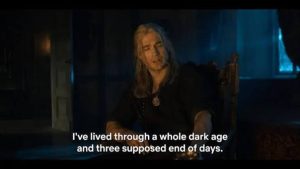
Geralt’s words to Nivellen are clearly hyperbolic in this context. If anything, modern Heathenry would be the weird electrical fire to the inferno of Geralt’s dark ages and end of days.
Still, hyperbole aside, Geralt’s underlying sentiment of exhausted boredom is very familiar all the same. Having been Heathen since the 90s, I feel like I’ve seen every bullshit argument and variety of Heathen drama there is. Even outside those disputes and schisms, it’s rare for me to encounter discourse that’s not just a re-run of previous conversations or some 20th century crap repackaged for the 2020s. As far as weird electrical fires go, ours is just smelly enough to be annoying, but hardly ever Kenough deep down to ignite into something truly interesting.
And unfortunately, that last part is especially true when it comes to the runes.
Runes: The Repackaging
To be blunt, the vast majority of modern runic divination and magic is recycled Ariosophic and Armanist wank, hence why so much of it has the freshness of a jar of old farts. If this is your first time hearing that, I now regret to further pollute your brainmeats with the following nonsense.
(Don’t worry, I’ll pray to sweet baby West Virginia Opossutyr for you. I’m not a complete monster.)
You can read about Ariosophy and its shitty offspring, Armanism, for free in more depth here. The TL;DR version, though, is that Ariosophy is what happens when Theosophy and old timey “race science” firkle around in the brains of early 20th century Germans. It’s only a matter of time before people start fapping off over notions of magical blood.
Or in other words, it’s all horseshit.
However, unfortunately for modern Heathenry, shades of that horseshit are alive and well in most of the books out there on runes. (Thanks to a certain well-known author including Armanist ideas in his work.) Even now, that shitty runic story dreamed up by a fake aristocrat during the last century remains the runic story for far too many Heathens.
So, when I come across new takes on runes, rune magic, and runic divination, I tend to get a bit excited. Modernity isn’t bad (and let’s be clear, this is all modern in origin). It just needs to be clearly labeled as such. And well, if a bunch of 20th century Germans could just make shit up, why not us moderns, too?
As long as it works, right?
If nothing else, we can at least find a better magical story for the runes.
Runes: The Renegotiation
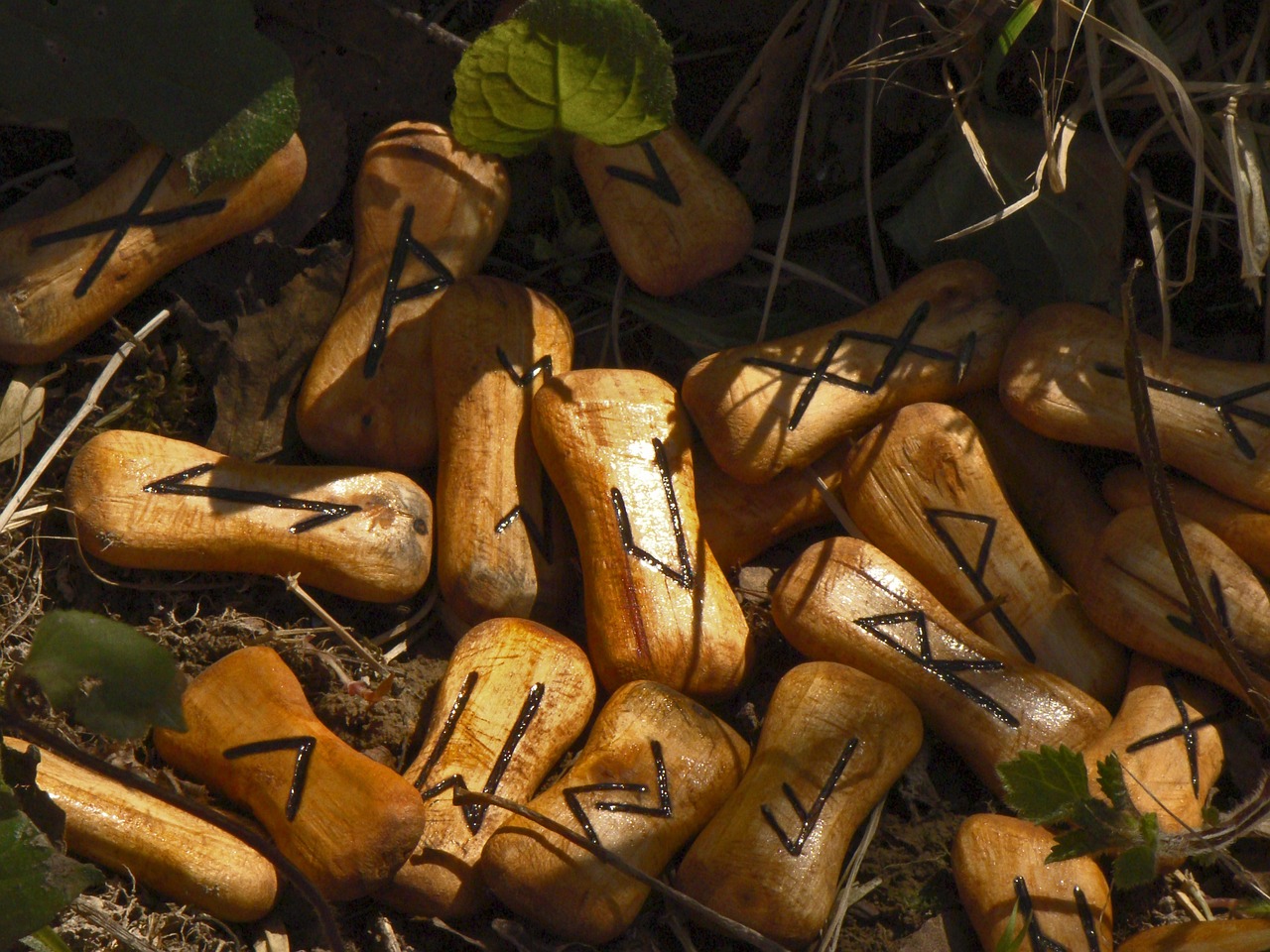
This past year or so, I’ve had the pleasure of working with a runic divination deck created by a local-to-me artist. Like many when they first come to the runes, she found it hard to connect the meanings derived from the rune poems with the forms of the runes themselves. For people more habituated to the richer pictorial world of Tarot, this can be quite a leap. So being an artist, she got to work. Then she reached out to a bunch of us local Heathens to let us try out her deck and get our input on her “little white book” of meanings.
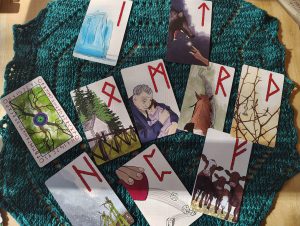
In my experience, runic divination decks can be very hit or miss, but this one gets the inspiration flowing. Much like with Tarot, I find specific elements of the imagery drawing me in when I read. The runes can be as ambiguous as they are blunt, so subtle psychic hits like that are helpful.
Why I Like Them
I’ve written about this before, but our brains are hardwired for story, and one of humanity’s first forms of storytelling was art. These cards help with the storytelling of divination. They create enough of an invitation for inspiration to visit without falling into the trap of shaping it overly much.
Moreover, in case it wasn’t already clear, this artist came to the runes from outside of Heathenry. This, too, can be hit or miss when it comes to the runes—the line between “refreshing” and “outlandish” can be incredibly fine—but she nailed it. As someone who believes that the runes themselves are a kind of Story-people, and that such people often speak through inspiration, I like to support artists who understand their role in that sacred exchange. Her “little white book” combines her own intuitions as both a practitioner and artist (some of which reflect previously unknown-to-her older source material), the “standard” meanings, and the input of Heathens with decades of experience in rune-reading.
While not particularly a new take, I find these cards something of a renegotiation of the modern tradition as it stands. Rather than completely upending the old story, they make a space for inspiration to take root. The old story remains, but is no longer ossified into tradition, divorced from the fluid realm of story. When I hold these cards in my hands, there’s a sense of freshness there and possibility. An invitation to look beyond. More importantly, my Holy Powers seem to enjoy speaking through them as well.
The artist is Angela Raincatcher, and if you dig what you’ve heard of them, you can email her for purchase at the address beyond this link.
The Runes As Story
Speaking of inspiration, I once got the sudden sense that the runes were collectively a story, and more specifically, that of the foundation and growth of human society. This was back in November 2020, so six years ago now. But I remember feeling as though I’d just discovered something critical—a piece of the puzzle I’d been missing all along.
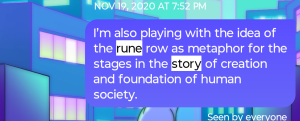
Inspiration, however, doesn’t always land where it’s meant to, and I was not the right soil for that seed. The sense that had felt so urgent soon fizzled to a low buzz somewhere in the back of my mind. So, imagine my surprise when someone in my local community wound up growing that same seed!
Reader, if that isn’t the coolest shit ever, I don’t know what is.
They announced the completion of the book they birthed from that seed at a community Yule event last year. The rune poem carrying the story had come to them one night, then they’d hammered it into something that others could learn, which is no mean feat. I picked up my copy at Sacred Space earlier this year, and I’ve been in love with their Eight Paths Method ever since.
Introducing The Eight Paths Method
Unlike other systems of runic divination, the 8 Paths Method requires both a bespoke cloth and a trio of eight-sided runic dice. The reader casts the dice on the cloth, then goes from there.
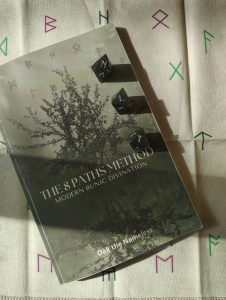
However, what truly makes the Eight Paths Method stand out is the interplay between the story-poem based meanings of the dice runes with the more “standard” meanings of the cloth runes. Much as the name suggests, the cloth is divided into 8 slices or “paths”, each representing an area of life. They are then in turn joined by the eight spokes, a trio of runes on each, that extend out from the Ear rune at the center of the cloth. Where the paths represent areas of life, the spokes speak to the layers of interaction between self and world. The individual and their actions are inseparable from the wider web, and this method reflects that.
Why I Like It
Frankly, I find the Eight Paths Method utter genius. It not only removes that aforementioned curse of ambiguity, its story-based container enables actionable readings that are inherently holistic in nature. Rather than having to guess what and where the issue is (and how to solve it), the Eight Paths Method reads you for filth, reminds you of that wider context, then sends you off with a prescription for change.
And did I mention the accuracy?
In my experience, the Eight Paths Method is ridiculously accurate. Like a well-oiled machine, it just works. I’m not saying it’s how rune reading was originally, as that would be stupid. But I do think that whichever Power or Powers planted that seed did us all a solid. I’m also very grateful that Oak the Nameless was able to grow it as they did.
You see, that’s the thing about magic: it’s always originally come from the Other and/or Holy. Historical sources are wonderful, but I’m also not so foolish as to think the Powers’ toolboxes are anywhere close to being empty. The real trick is discerning the true inspiration from pale human invention. And well, the proof for that is usually in the pudding, as they say.
If any of this has you curious about the Eight Paths Method, you can find the book here. While you can make your own cloth and dice, Oak the Nameless also sells them here.
Final Words
I’ve been meaning to write this post for a while now, but the words just weren’t there. I do hope you check out these tools and at least follow these creators, as they’re awesome. Now, more than ever, I truly believe we need new and better stories about the runes, and well, Heathenry in general. Too many of us have become insects stuck in the amber of our unexamined religious baggage, ideas about legitimacy, and inherited bad stories from the early days of the Heathen revival.
However, much like northwestern Europeans in the migration period, we also live in a time of intense change. A wolf-age, so to speak. The kind of times that break worldviews and force people to change. Sooner or later, that amber is going to break.
And what then?
As mentioned above, we humans are not the original source of magic. There’s more to be discovered than what remains in the historical sources. Don’t get me wrong, those sources are important—a necessary prologue—but they can’t be the whole practice. That prologue may partly shape our current story, but we cannot relive it in any real sense. To do so would be to mistake a single puzzle piece for the whole puzzle. That’s fine for reenactment, but living tradition is entirely another matter.
Unlike reenactment, which can only exist in limited pockets of space and time, living traditions inhabit the whole world as it is now. If our goal is to create a living tradition—one with enough depth to nurture and sustain entire generations—we need the water of gnosis and inspiration. There has to be space to create new things within our traditions (no matter how uncomfortable some among us may find it).
Well anyway, that’s it from me for now.
Be well.