
Narrative DESTROYS Facts And Logic! Authenticity FLEES!

If you’re anything like me, you probably hated that title. Hell, I hated typing it! But this is a post about ersatz, and as algorithms are some of its main purveyors, it seemed fitting to start with some clickbait.

The last time we met in this space, I talked about the growing thirst for authenticity I perceive in the overculture. Whether that perception is accurate remains to be seen, but ultimately it doesn’t really matter. Houston, we have a problem either way.

If you haven’t already read that post, I recommend that you do so before continuing. Then, my focus was on the science of perception, processing, and bias. Or to quickly summarize: No human perceives reality as it actually is. Instead, we navigate this existence via a working model created and constantly modified by the brain in response to sensory input. This was what I meant by the “unrealness” of reality—a term of my own creation. As someone for whom words are containers for meaning, I often find myself crafting containers for the families of meaning that don’t fit my mother tongue’s current forms.

Simply put, my “unrealness” container is a stand-in for “perception” that also implicitly acknowledges that we humans all experience reality by proxy. If we let it, it can serve as a reminder that the “real” is often not nearly as important as the stories we tell to give it shape.

In my previous post, I mostly stuck to the most common scientific “maps” of this particular territory. However, as the saying goes, “the map is not the territory.” And in my opinion, those scientific maps are missing some layers. They show the equivalent of roads, landmarks, and businesses, but say nothing of the topography, ecosystems, and local culture of a place.

Here begins the process of filling in some of the missing layers that are not so easily labeled or explained. The souls-filled and magical. The inspired and Unseen.

Well, would you know yet more?

Ersatz Like Cobwebs

First though, a story of a dream (so really, a story within a story).

How delightfully meta!

The year was 2022, and my family and I were visiting my parents back in Lancashire, England during the winter break. It was my first trip back in over a decade, and my daughter’s first trip to where her mother grew up.

One night while there, I had a dream. I was rushing along country lanes, long and winding like snakes, the land around me smothered by layers of cobwebs. Now, these weren’t some Otherworldly roads, mind you. That’s just how a lot of the lanes there are—winding serpents of pitch and gravel through tunnels of trees. All snakes I’d set my boots to countless times in waking life.

After a while, I came to a stop and turned to the hedgerow lining the lane. Somehow, I knew I’d reached my destination for the night—that that was where I was supposed to enter. By this point, I was fully lucid in my dreaming. I could have easily turned back the way I came. But Necessity was loud in my souls, so I pushed through the shadows and thorns until the hedge opened up, and I found myself in what appeared to be a council chamber.

Looking around, I saw that numerous peoples had gathered there for a meeting—everybeing from the plant, tree, and animal peoples to the Unseen and Otherworldly. As the only human there, it wasn’t long before I attracted some attention, though perhaps not in the way you might think. Apparently, we humans had always had a place at the meeting. It had just been a good long while since any of our kind had last filled those seats.

The reason, I was told, was the cobwebs. According to my hosts, what I’d perceived as webs were really the layers of stories woven over the human population by those who’d remain in control. The only reason that I finally made the meeting (or could even see those webs to begin with) was because my time away had first loosened, then shaken their hold. Nowadays, I wholly believe those “webs” are what people are referring to when they speak of “the veil.”

Toward A Definition of Ersatz

No matter its name, that barrier or binding is largely what I mean by “ersatz.” My container this time is obviously a borrowing altered from its original form. But “container” struggles seem par for the course when it comes to discussing this subject. The writer James Joyce, for example, named his container “false art” or “improper art,” which J.F. Martel summarizes in the following way:

’Proper art stills us, evoking an emotional state in which “the mind is arrested and raised above desiring and loathing.” Improper art does the opposite, aiming to make the percipient act, think, or feel in a certain prescribed manner.’ (Martel, Reclaiming Art In The Age of Artifice. 26-27).

You may wish to put a pin in that part about “desiring and loathing.” I’ll be returning to it toward the end.

Much like that “false” or “improper” art, my borrowed “ersatz” is any story that binds and keeps us closed off to inspiration, and/or controls and makes us another’s tool or weapon. Ersatz is the stories that trick us into believing ourselves separate from, maybe even better than, other humans due to inborn qualities. It’s the stories that have us reaching into our pockets for money we don’t have for some product to fix everything (usually while also convincing us that we’re brands too).

Tired of Capitalism 1.0? Try Capitalism 2.0 instead! Think you know REAL Capitalism? Think again! 100% guaranteed to make you rich!

(Terms and conditions most definitely apply.)

Ersatz is propaganda and marketing and nationalist myths of blood, soil, and divine destiny. It’s the various “programs” or ideologies by which our societies run. To quote Martel again (who’s clearly also in the container business), ”Proper art moves us, while artifice tries to make us move.”

And unfortunately, that artifice or ersatz is more prevalent than ever before.

According to Samuel Spitale in the introduction of How To Win The War On Truth, the average American is subjected to anywhere between 4,000 to 10,000 media messages a day (up from around 1,600 fifty years ago).

No wonder so many of us struggle to find the space for Authenticity’s seeds.

Weaponized Ersatz: A Two-Headed Beast

So, we have our ersatz, already monstrous but still growing. Worse still, this beast is polycephalus. For the purposes of this post, I’ve set a two-head limit for this word-woven creature. After all, nuance often gives way to endless rabbit holes without proper boundaries. And well…this post is already a warren.

With that said, let’s meet our fiend!

A loud roar suddenly shatters the silence as the beast rises. Its feet make dust of hard rock. Terrified, you begin to retreat, your heartbeat a war drum in your chest. The land shakes as it takes a step, and, unable to look away, you stumble and lose your footing. Palms aching, you take to shuffling backward on your butt—anything to escape. But then the land shakes again as it takes another step, and realization sinks in as hard as the stone making raw meat of your skin. Your desperate shuffle could never match a monster’s stride. Blood like ice, you freeze. Instead, you stare at the two heads swaying like snakes, their mighty maws open wide, and prepare for the end.

Dear Gods, please let it be quick…

One head lowers, and you find yourself choking on its breath. “WHEN YOU’RE HERE, YOU’RE FAMILY!!” it bellows, the words so loud they rattle your bones.

A half-second later, its twin lets out a second booming slogan. “MAKE AMERICA GREAT AGAIN!”

The laughter slips out before you realize it.

“Fuck me, Marketing and Propaganda?” you manage between cackles. You sound insane, and maybe you are, but this beast makes crazy people of us all anyway. The two heads cock to one side, and you laugh even louder. “I’d rather a fucking demogorgon!” you snort.

(Me too, fictional scenario person. Me too. At least demogorgons aren’t the bestial equivalent of glitter.)

A Natural History Of Glitter

When I first began looking into the history of this beast, I’d assumed it would be easy. There are, after all, entire courses on these subjects. However, I quickly found that most of the relevant sources treated marketing and propaganda as completely different entities rather than parts of the same beast.

In my opinion, this is a flaw at best. Not only does it obscure the commonalities between the two heads, it also shrouds the extent of its reach in our lives. Worse still, I would argue that, much like Pavlov’s salivating dogs, the marketing we consume as benign actually primes us for propaganda as well.

But more on that shortly.

Whenever I research a subject, I first seek out the root—the “origin story,” so to speak. Without those “first layers” or “prologue,” I find it hard to fully anchor a subject in my mind.

Unfortunately for me, this glittery beast has no clear parentage. That tendency to see two different beasts instead of a singular fiend obscures its origin story as well. So, a person working within the “two-beast” model with a focus on marketing, for example, might cite Adam Smith as the father, as he is considered the originator of the concept. However, a second person with a focus on propaganda might cite Sigmund Freud’s nephew, Edward Bernays, as the father of “public relations” (itself a rebranding of propaganda) instead.

Faulty modeling aside, however, we are dealing with the same beast. In his 1928 book Propaganda, Bernays writes about propaganda and public relations for commercial and political ends without differentiation. Where nowadays we might say that marketing sells products and propaganda ideas, it was all the same toolkit to Bernays.

Interestingly, he also makes it clear that a group he refers to as the invisible government—shadowy figures who understand the mechanism and motivations of the public mind—uses that same toolkit to rule over the people as well (Bernays. 9-10).

”The minority has discovered a powerful help in influencing majorities.”
(Bernays. 19).

Given that the “powerful help” is our beast, it’s little wonder the mist between the two heads is so damn thick!

The last time I darkened this digital domain, I talked about some of the recent research into perception, emotion, and bias. Now obviously, Bernays had none of those modern discoveries to pull on, but he was very familiar with his uncle’s work (as well as that of some of his contemporaries). Where his predecessors, the “old propagandists,” relied on “the psychological method of approach” (in other words, arguments based on facts and logic), Bernays focused on influencing the “mental pictures” in the public mind (Bernays, 106-107).

”Modern propaganda is a consistent, enduring policy of creating or shaping events to influence the relationship of the public to a given enterprise.

This practice of creating circumstances and of creating pictures in the minds of millions of persons is very common. Virtually no important undertaking is now carried on without it, whether that enterprise be building a cathedral, endowing a university, marketing a moving picture, floating a large bond issue, or electing a president.” (Bernays, 25)

Over the years, Bernays worked on both commercial and political campaigns alike, influencing American life in surprising ways. In the 1920s, for example, a time when smoking was not so common among women, Bernays ran a campaign for Lucky Strike that equated smoking with women’s rights and presented cigarettes as “torches of freedom” (Spitale. 14-16). It’s also thanks to Bernays that hairnets became ubiquitous in food service. As shorter styles became more fashionable among women, hairnet sales sank. To remedy this, Bernays convinced health officials to make them a requirement for food service workers (Ibid. 16). He is also why people came to consider disposable cups cleaner than reusable options, and why men now also wear wristwatches and no longer consider them women’s jewelry (Ibid.)

Most infamously, however, Bernays produced propaganda for the United Fruit Company (now Chiquita) against the democratically elected government of Guatemala, labeling them “communists.” This helped to enable a CIA-backed coup that led to decades of dictatorship and civil war for the poor people of Guatemala (Ibid. 16).

(This was also the origin of the term “banana republic,” by the way.)

So yeah…absolutely abhorrent.

As significant a parent as Bernays was though, he’s clearly not the only “daddy” in the mix for our beast. Unsurprisingly, this being is more homunculus than anybeing naturally spawned. (Gods, what a collection of words!) Moreover, there may also be some earlier, magical parentage as well.

Marketing, Propaganda, And The Magic Of Desire

This next part begins with the work of Ioan Petru Culianu. In life, Culianu was a Romanian-American historian known for his books on certain niche aspects of renaissance thought. A practicing magician who sadly met his end in 1991 in his bathroom courtesy of a bullet to the head.

A murder that remains unsolved to this day.

Well anyway, one of Culianu’s main academic foci was the writings of Giordano Bruno, a friar-turned-magician who was burned for heresy in the year 1600.

In his book Eros and Magic in the Renaissance, Culianu uses Bruno’s essay On Bindings In General as a framework to examine the possible connections between renaissance magic and mass-media marketing. For Bruno, the key to magic was eros (desire).  Along similar lines, modern advertising manipulates consciousness via images that spark desire. Sex sells either way.

Nowadays, we don’t typically think of marketing and propaganda as magical arts. However, Culianu considered this desire-based manipulation the very foundation of political power in modern industrial nations (referred to by Culianu as “magician states”) (Greer. The King In Orange. 19-21).

A Souls-Familiar Layer?

Emotions have long been understood to be magically potent. In Heathenry, the furious god is also the “Father of Galdr” or verbal charm magic. A form of magic that not only marries narrative (and sometimes also poetic meter) with intense emotion and modes of performance. Speak a galdor while utterly enraged, and you’ll probably get some spectacular (not to mention quick) results.

However, fury isn’t the only emotion that appears in connection with magic in the Norse sources. The other main emotion was familiar to both Bruno and Bernays.

Desire.

In the Old Norse sources, both fury and desire are stirrings of the same soul. This is the Hugr, the most “occult” of a person’s souls, you might say. Although better attested in Norse sources, cognate forms appear in all the older Germanic tongues, all of which rooted other words. Among the early English, Hugr was known as Hyge, while a speaker of Old Saxon would have referred to their Hugi instead. In Old High German, the word was Hugu, and in Gothic, it was Hugs.

Broadly speaking, Hugr is “mind,” “heart,” “desire,” and “longing,” though I should also note that these cognates do differ slightly in meaning. For example, the Old English Hyge could be “thought,” “mind,” “courage,” “intention,” “heart,” “disposition,” and “pride.” The Gothic Hugs, however, primarily carried meanings of “thought,” “intelligence” and “understanding” with none of the heart.

Overall, the best summary of Hugr as I understand and experience this soul comes from Snorri Sturluson in Skáldskaparmál chapter 86:

“Thought (Hugr) is called mind and tenderness, love, affection, desire, pleasure…Thought is also called disposition, attitude, energy, fortitude, liking, memory, wit, temper, character, troth. A thought can also be called anger, enmity, hostility, ferocity, evil, grief, sorrow, bad temper, wrath, duplicity, insincerity, inconstancy, frivolity, brashness, impulsiveness, impetuousness. (Faulkes trans. 154.)

As I said earlier, they are the most “occult” of our souls. At times in the sources, they give counsel, while at other times they appear to be a ward. A protector. They are also a wanderer, capable of independent movement from the human whole.

Most important of all though, Hugr has force. They are the fury in the galdor and the lust in the seiðr, they are the difference between empty words and gestures, and tangible result. Hugr is what makes Wish real in the world.

All of which makes Hugr the main prey of our two-headed beast.

Where marketing works to ensnare Hugr with bait made of carefully crafted wishes, propaganda ensnares by stirring up rage and offering nightmarish possible futures to appeal to Hugr-as-ward. If we’re not careful, this beast can make monsters of our Hugr over time as well.

And that, Hel-friends, is a recipe for disaster that lasts long after the screen has gone dead.

Final Words

I was planning to follow up with another post on this topic directly after this. However, the thing about exploring such huge subjects is that, sooner or later, I begin to feel trapped. Suddenly, I find all kinds of other things to talk (ahem, rant) about and find myself getting annoyed. Eventually, I lose interest and cease writing full stop.

So, this time I’m trying something different.

I’m going to post that stuff anyway instead of trying to stick to one series at a time. Expect the unexpected, I guess!

That said, I’m not nearly done with this subject. So far I’ve focused on the effects on individual humans, but I’m yet to touch on mass effects. What happens when significant numbers of Hugr-twisted humans obsess over a practitioner of New Thought who markets themself as a brand? How about when big tech takes a huge dump in the information space? More importantly, why even take that dump in the first place after warning of its dangers less than a decade ago?

The technology might well be new, but the playbook really is not.

Until that next time though, I really encourage you to check out Winifred Rose’s work on Hugr. One of the very best things I’ve ever done for myself both as a human and Wicce is to get to know mine. Nowadays, my Hugr and I are more intentional in our collaboration. Better still, we’re both learning to spot that beast’s bait.

An important practice in our increasingly brain-cooked world full of people with out-of-control and twisted Hugr-souls!

So, until then, be well, Hel-friends and stay safe.
<3

Sources

Bernays, Edward. Propaganda (Original Classic 1928 Edition): The Definitive and Complete Masterwork on Public Relations. 2025.

Greer, John M. The King in Orange: The Magical and Occult Roots of Political Power. New York: Simon & Schuster, 2021.

Martel, J.F. Reclaiming Art in the Age of Artifice: A Treatise, Critique, and Call to Action. Berkeley: North Atlantic Books, 2015.

Spitale, Samuel C. How To Win The War On Truth. 2022.

Sturluson, Snorri. Edda: Prologue and Gylfaginning. Translated by Anthony Faulkes. Oxford: Oxford University Press (UK), 1982.

 

What is a Witch?

Which Witch is Witch

What is a witch, and who gets to call themselves one? If ever there were two more controversial or ire-provoking questions than these, I am yet to find them. Nowadays, those of us who live in the post-Industrial nations of the world treat the word “witch” as a title to claim and squabble over. Which is ironic really, when you consider that for many centuries, the witch was a person to fear, a bane on cattle and crops; and for those who were accused of being one, a path to prosecution and possibly either the gallows or pyre.
I’ve already blogged about the origins of the word “witch,” or more specifically, the first attestations of its Old English ancestor: wicce (f)/wicca (m)/wiccan (pl). As I argued then, given the contexts in which those attestations appear and their clear parallels in Old Norse narratives of Heathen magic and magical practitioners, the first Witches were most likely a kind of Heathen ritual or magical specialist.

Now, that’s all well and good. But what about practitioners today? After all, not everyone claiming or squabbling over the title of “witch” is a Heathen. If anything, most seem to consider Heathenry and Witchcraft two completely separate paths—paths that are, for the most part, largely in opposition to each other. Additionally, for many within the Traditional or Folkloric Witchcraft communities, the “real” witches were Christians, and it’s the Pagans and Heathens who are the latecomers to the Craft. (Another irony given those aforementioned origins!)

Perception and Meanings

So, with all that said, where do we go as modern practitioners? Because believe it or not, this isn’t about telling everyone they have to be Heathen or GTFO of the Craft!

The thing about words is that their meanings change over time. People have literally spent centuries altering the definition of witchcraft to fit their social, political, and religious agendas. “Witch” and “witchcraft,” simply put, were labels of exclusion used to delineate and enforce the boundaries of society while identifying those people, practices, and beliefs perceived to be harmful to that order to eradicate them (see Kieckhefer cha. 8 for further discussion). Given the central role of perception here—which is itself incredibly malleable and largely shaped by belief—it’s little wonder those definitions have shifted so much over the centuries. That perception of harm is why it was entirely possible for the same person to be considered a “cunning person” or “charmer” by some, and a “witch” by others. To quote Kirsteen Macpherson Bardell in her paper, Beyond Pendle: the ‘lost’ Lancashire Witches:

“Again, the evidence indicates that healers had a widespread reputation in the community but that this ambiguous connection with magic could turn into suspicion of something more malevolent.”

“Pendle, old Pendle, thou standest alone.”

The witch who could heal could also hex, and all that. A precarious position for any practitioner.

Moreover (and to further complicate matters), “witch” has become the go-to gloss for any word used to describe ritual specialists in other cultures as well, its application largely dependent on how those practitioners were perceived by cultural outsiders. This not only expanded the definitions of “witch” even further, it also obscured, shifted, or even outright erased the original understandings those cultures had of those practitioners. (An accusation we can also lay at the feet of the appropriated version of the term “shamanism” as well, if we’re being honest.)

Either way, it’s little wonder we have so much to argue over now.

Unfortunately, the truth of the matter is that outside of its original cultural and religious context, the word “Witch” doesn’t really have a fixed meaning. Both now and in the past, it’s been used as a box of sorts. For some, that box was a place to toss the people and things they wanted to get rid of, while for others, that box holds something treasured to be gatekept. In one box, lives one kind of person’s nightmares, whereas the other box holds another kind of person’s ideals and dreams.

Again and again, it’s perception that shapes those walls.

The Familiar Thread

Nebulous though the meanings of “witch” can be, however, there is something more solid to be found in that cloud. A way to sort through the mist, if you will. As unlikely as it may seem, there is a core there that exists regardless of religious belief, socio-political goals, or mystical aspirations. We see this core in a theme that is repeated over and over from the eleventh century writings of the early English homilist Ælfric (and likely earlier) to the early modern English and Scottish trial accounts.

This surprised you, didn’t it? Come on, admit it!

It’s the presence of “devils” or familiar spirits, be those familiar spirits Otherworldly or Dead. A thread that predates the development of the continental witchcraft narrative by centuries.

“Now some deceiver will state that witches (wiccan) often say truly how things will turn out. Now we will say truly that the invisible devil who flies around the world and sees many things makes known to the witch what she may say to men so that those who seek out that wizardry may be destroyed.”

From De Auguriis by Ælfric of Eynsham

In my blog talking about those earliest attestations of wicce/wicca/wiccan, I discussed the strong parallel between King Alfred’s 9th century renegotiation of Exodus 22:18 and the image of the Old Norse seeress or völva in the Poetic Edda poem Völuspá. To summarize for those of you who are yet to read that post, both the wiccan of Alfred and the völva of the Edda were portrayed traveling between homes, exchanging magic and seership for the hospitality of their (predominantly female) hosts—a theme we see repeated a number of times in the Old Norse sources.

Given the common root of the early English and Norse cultures and their history of exchange and interaction, shared themes or patterns can hardly be surprising. Yet despite this long relationship, even the suggestion that early English witches might have been analogous to the Norse völur in some ways is still somewhat controversial.

Perhaps it hits too many of the same buttons indiscriminately smashed by Margaret Murray for comfort? Or maybe anti-Wiccan sentiment among modern Heathens is to blame? I suspect both may be a part of it. However, it’s also important to point out here that the völva (much like the shaman) isn’t nearly so tarnished by those centuries of negative PR. This is especially the case among Anglophones, but it likely extends into other cultures too given the outsized influence of Anglophone media on the rest of the world. In short, völva has a certain cachet that “witch” simply doesn’t have and perhaps offers a way to be “witchy” without inviting the same degree of hostility from others. Any comparison between the two then must feel like a sullying of something dearly held.

You see, even as Pagans and Heathens we are shaped by those Christian perceptions; some of us still borrow our prejudices instead of setting them aside.

Devils? Nah. Let’s Talk Elves and Witches!

However, to return to my point, that partnership between witches and so-called “devils” also appears in Old Norse sources. Over and over, we find female magical practitioners in league with other-than-human people.

For example, in Ynglinga saga, Freyja (a goddess associated with magic referred to as seiðr) is described as a blótgyðja or “sacrificial priestess” and appears to lead the cult centered around her brother’s burial mound. Her brother, of course, is Freyr, a god described as the ruler of Álfheimr or “Elf Home” (cognate to the Scots word Elfhame) in the poem Grímnismál. Another place we see this partnership between a “witch-coded” priestess and elf-coded male is in chapter 28 of Örvar-odds saga, where we find a king by the name of Álfr (literally “elf”) and his wife Gyðja (“priestess”), who appears connected to Freyr. Gyðja is also depicted shooting magical projectiles from her fingernails, an ability we also see demonstrated in Jómsvíkinga saga by the goddess Þorgerðr Hölgabrúðr, who Hilda Ellis Davidson identifies with Freyja (Davidson, Roles of the Northern Goddess pp. 177-178).

And while we’re on the subject of magical projectiles (also known as “elfshot”), allow me to mention a couple more sources that feature this theme as additional illustrations of this partnership. The first source I want to mention is the 10th century metrical charm Wið Færstice (“Against a Stitch”), which features a narrative set at a burial mound that likely describes witches shooting projectiles made by elven smiths. The second source I want to mention is the confession of the 17th century witch, Isobel Gowdie, in which she claimed to obtain her magical projectiles from elves (and the Devil), who made their houses in mounds (Alaric Hall, Elves in Anglo-Saxon England pp. 112-115).

Despite the centuries between them, the narrative of Wið Færstice and themes of Isobel Gowdie’s confession align in that both involve witches shooting elf-made magical projectiles and mounds. Quite remarkable when you think about it! Clearly, those things go together like PB&J!

(Can confirm.)

I could go on (no really, I could; this is my special interest). I’ll spare you all for now, though. We’ll be here all day otherwise.

Moving Forward

The partnership between witch and familiar is perhaps one of the oldest and most consistent threads of the witchcraft story regardless of era, at least as it has played out among English and Scots-speaking groups in mainland Britain, or in other words: those groups who once would have likely used the words wicce/wicca/wiccan in their daily speech. While this pattern can also be seen in other cultural groups within the British and Irish Isles as well as continental witchcraft narratives, those are beyond the scope of this post.

Now does that mean that everyone has to have a familiar spirit in order to be a “real” witch?

Not necessarily. What I will say, however, is that one does have to be somewhat other. Some of us come by that otherness via ancestry i.e. someone way back when made some connections that subtly changed them and those who came after them, while some of us become other through encounters with the Dead and/or Otherworldly, eventually founding relationships. It may not be popular to say this, but that’s the thread.

Some Personal Theorizing

My personal theory is that the witch originally began as an analog of the Old Norse gyðja, who, as Terry Gunnell points out in his paper Blótgyðjur, Goðar, Mimi, Incest, and Wagons: Oral Memories of the Religion(s) of the Vanir, was mostly associated with the cult of Freyr in the sources. This interpretation would accord well with the etymology put forth by the linguist Guus Kroonen, which traces the word’s derivation from the same linguistic roots as the Proto-Germanic *wiha-1 and *wiha-2 (“holy” and “sanctuary”). A second etymology that also accords well with this interpretation considering the centrality of burial mounds in some of these narratives is that given by the American Heritage Dictionary of Indo-European Roots, which traces wicce/wicca to the Germanic *wikkjaz or “necromancer.” An association that also appears in the later Aldhelm glosses as well.

“This is my church. This is where I heal my hurts.
For tonight, god is an (elf) DJ.”

Final Words

Still, that thread doesn’t erase those centuries of loose meanings and adaptations. If the word “witch” inspires you, then I encourage you to respectfully take on that mantle. I am not here to police or gatekeep you or your practice. That’s just tiring and pointless. As I’ve said before (many times), the Craft protects itself. Just know that the witch-mantle is weighty and can get you into trouble. Be mindful of its history, both the good and the bad, and remember on whose side you stand.

And whatever you do, never, ever forget the possibility that it all began with devotion and service.

Now, wear that mantle accordingly.

Sources

Davidson, Hilda E., and Hilda R. Davidson. Roles of the Northern Goddess. London: Psychology Press, 1998.

Hall, Alaric. Elves in Anglo-Saxon England: Matters of Belief, Health, Gender and Identity. 2007.

HarperCollins Publishers. “Appendix I – Indo-European Roots.” American Heritage Dictionary – Search. Accessed May 9, 2025. https://ahdictionary.com/word/indoeurop.html.

Kieckhefer, Richard. Magic in the Middle Ages. Cambridge: Cambridge University Press, 2021.

Kroonen, Guus. Etymological Dictionary of Proto-Germanic. Brill Academic Publishers, 2013.

Poole, Robert, and Kirsteen Macpherson Bardell. “Beyond Pendle: the ‘lost’ Lancashire Witches.” In The Lancashire Witches: Histories and Stories. Manchester: Manchester University Press, 2002.

Seven Viking Romances. London: Penguin UK, 2005.

Sturluson, Snorri. Heimskringla: History of the Kings of Norway. Austin: University of Texas Press, 2010.

Terry Gunnell. “Blótgyðjur, Goðar, Mimi, Incest, and Wagons: Oral Memories of the Religion(s) of the Vanir.” The Center for Hellenic Studies. Last modified March 30, 2021. https://chs.harvard.edu/chapter/part-ii-local-and-neighboring-traditionsterry-gunnell-blotgydjur-godar-mimi-incest-and-wagons-oral-memories-of-the-religions-of-the-vanir/.

“Örvar-Odds Saga.” Snerpa.is / Heim. Accessed May 9, 2025. https://www.snerpa.is/net/forn/orvar.htm

The Origin Story of the Witch

Wiccan, Wicca, Wicce, Witch

Over the past few months, I’ve been digging into the 9th to 11th centuries in early English history. This was a tumultuous period to say the least. A time of warfare in which two very different possible futures hung in the balance.

It was also during this time that the word wiccan (“witches”) made its first appearance in the textual sources.

Nowadays, most understand Wiccan to refer to a single practitioner of the neopagan religion Wicca. For the early English though, wiccan was always plural, and a wicca was a male witch. The feminine form of the noun, wicce, eventually became our modern word “witch.”

(Yes, Gerard Gardner chose the singular masculine form of the noun to name his religion. How…utterly unsurprising of him.)

Over the centuries, “witches” have been blamed for all manner of social ills—everything from the ritual murder of infants (a version of the antisemitic blood libel accusation) to blighting crops and causing disease (both of which were also accusations used to wipe out entire communities of European Jews). The meanings of the word “witch” have shifted over time. It’s become something of a malleable term, all too often weaponized. A tool for policing behavior, enforcing dogma, and exerting control.

But that is not the subject of today’s post. That ground is well-trodden enough. No, today I want to talk about the original meaning of the word “witch” and, more importantly, its relationship to early English Heathenism.

The Witch Appears

One of the earliest mentions of the Old English plural form of “witch”, wiccan appears in a passage from the prologue of King Alfred’s Dombōc (law book) (Elsakkers 2010). Now, there is an earlier attestation of the related word wiccungdōm in Cædmon’s Paraphrase that likely dates back to the 7th century (Thorpe. p. 223). However, for this post, I’m going to limit myself to sources including the words wicce, wicca, wiccan and wiccecræft, as well as the verb wiccian.

Anyway, back to Alfred’s Dombōc. The prologue of the Dombōc included sections of chapters 20-22 from the Book of Exodus, ostensibly translated into Old English.

Unsurprisingly, we first find the word wiccan in Alfred’s “translation” of Exodus 22:18 (“Thou shalt not suffer a witch to live.”):

Þa fæmnan þe gewuniað onfon [anfon] gealdorcræftigan [galdorcræft] 7 scinlæcan 7 wiccan, ne læt þu ða libban.

(The women who are wont to receive [and assist] gealdorcræftigan and scinlæcan and wiccan, let them not live.)
(Elsakker 2010)

As you can see from the above quote, Alfred’s treatment of this verse is more reinterpretation than translation. Where the author of the Hebrew Bible punished the mekhashepa, Alfred instead punished the women who welcomed them into their homes and helped them.

But why?

Alfred’s Source

Alfred’s main source was the Vulgate, a 4th century translation of the Hebrew Bible. However, that does not seem to have been his only source. Consider the Vulgate translation of Exodus 22:18 below.

“XXII. 18 maleficos non patieris vivere.”

As you can see, the Vulgate translates the Hebrew word mekhashepa as maleficos, a word that originally meant “evil doers” and carried no connotations with magic in earlier Latin texts. A terrible translation by any measure. But in the defense of the Vulgate’s translator, no other translation was possible. Thanks to the Theodosian Code anything even vaguely related to magic was considered maleficium (“evil doing”) and had been for decades before his birth. For 4th century Romans like Jerome of Stridon (the translator in question), there simply was no difference between charm-muttering healers and sorcerers (Hutton 2017). So, the fact that Alfred used three words where the Vulgate only used one suggests he must have had a secondary source.

“It’s me. Hi! I’m the problem. It’s me.”
– Alfred, never.

The most likely candidate for that secondary source is the Vetus Latina. This is a collection of Latin translations of the Septuagint, a 3rd century Greek translation of Hebraic traditions produced by Jewish scholars who were fluent in both Greek and Hebrew. Unlike the Vulgate that followed it, the Vetus Latina retained the nuance of the Septuagint. And this—more specifically, the Vetus Latina version of Exodus VII.11—is likely the source of Alfred’s own nuance (Elsakkers 2010). Because instead of the evergreen “maleficos” of the Vulgate, the Vetus gives us a trio of practitioners.

However, neither of Alfred’s sources explain the most significant change of the Dombōc version: the target. For that, we’ll have to widen our net.

An Old Norse Parallel?

When I first read Alfred’s law, I was struck by how similar it was to what we find in later Old Norse texts. The peripatetic seeress/magical practitioner that goes from house to house plying her trade is one that crops up in a number of sources, the most famous of which being Þorbjörg Lítilvölva from Eric the Red’s Saga. However fame aside, I think a better parallel to Alfred’s law (at least in sentiment) is verse 22 of the Poetic Edda poem, Völuspá.

”Bright Heiðr they called her
At all the houses she came to,
A good seer of fair fortunes
—she conjured up spirits who told her.
Sorcery (seið) she had skill in,
Sorcery (seið) she practised, possessed.
She was ever the darling
Of an evil wife.”

(Dronke trans.)

In my opinion, Alfred’s choice to condemn the women who received and assisted the practitioners in their homes instead of the practitioners themselves owed more to attitudes prevalent in his own culture than his sources. A culture that shared a common root with and engaged in centuries of interaction and exchange with the Norse.

However, unlike with the Romans, Alfred’s law wasn’t as simple as banning all magic. The presence of magical elements such as verbal charms and ritual acts in early English healing practices would have made such a ban impossible. They may as well have been trying to ban healing itself! An untenable position for any ruler, but especially for one whose rulership was under threat.
And this, friends, is where we come to a key part of this puzzle.

Christians, Danes, and Witches, Oh My!

At the time of the Dombōc’s writing, Christianity was in a perilous position in the English kingdoms. The conversion of the would-be English had begun in 597 CE with the arrival of the monk Augustine in Kent. Over the next two-and-half centuries, Christian missionaries spread their faith throughout the English kingdoms, with the city of Canterbury as their base. However, not all in the kingdoms were eager to receive the new teachings, leading the missionaries (on the pope’s orders) to “sweeten the pot” by co-opting Heathen practices and places of worship instead of simply banning them and tearing them down.

Generally speaking, Christianity spread first among the rulers. However, even after that initial conversion among the kings in the 6th century, some—such as Redwald of East Anglia—were persuaded back to the ways of their ancestors. And even when a king remained devoutly Christian in life, there was no guarantee his heirs would share his devotion. At least two of the kingdoms officially reverted to Heathenism with the ascent of Heathen heirs to their thrones in the 7th century (Knapp. The Fight Against The Threat).

And Christianity seems to have been even more precarious at the popular level. As Karen Jolly notes on page 45 of her book Popular religion in Late-Saxon England:

“The pagan hierarchical structure disintegrated rapidly in the seventh century in the face of Christianity’s systematic organization. But folk practices were all-pervasive in everyday life. The animistic character of Germanic belief prior to Christianization, with its emphasis on nature, holistic cures, and worship at wells, trees, and stones, meant that it was hard to counteract on an institutional level of organized religion. Small religious sites were everywhere; people carried amulets to ward off misfortune and relied on the belief in spiritual agents as explanations for many life experiences.”


That’s not to say that everyone at the popular level was practicing exactly as they had prior to conversion though. Over time, these practices were syncretized with Christian elements (Jolly. 45). Education in Christianity also seems to have been a concern for the church, as few at the popular level were literate—a situation that would remain well into the 11th century.
Then in the late 8th century, the Danes came. This was the world Alfred was born to and the wider context of his law book and education program. A world in which centuries of struggle to fully Christianize a land met a new challenge in the form of Heathen invaders.

Witches, Heathens, and Law

Alfred’s law book wasn’t just the first to mention witches, it was also likely a large part of why “witches” became synonymous with maleficos (and in turn, fordæða in Old Norse). Once included though, witches and witchcraft remained a part of the early English law codes, and persisted in English law long after other terms for practitioners fell away.

(A short note before I proceed: the following laws are pulled from M.J Elsakkers “Reading between the lines: Old Germanic And Early Christian Views On Abortion, which you can find linked at the bottom of the page.)

The first law code to actually sentence the witches themselves was the 10th century law code of Æthelstan, Æt Greatanleage II, which states (ModEng trans. only this time):

“Concerning witchcrafts (wiccecræftum). And we have pronounced concerning witchcrafts (wiccecræftum) and sorceries and secret attempts on life, that, if anyone is killed by such and he (the accused) cannot deny it, he is to forfeit his life”

This is repeated (along with a sentence of outlawry) in the 11th century law Eadward, Alfred and Guþrum:

“If witches (wiccan) or sorcerers (wigleras), perjurers, or murderers or foul, polluted, manifest whores are caught anywhere in the land, they are then to be driven from this country and the nation is to be purified, or they are to be completely destroyed in this country, unless they desist and atone very deeply.”

When we get to article 5.1 of Cnut’s law code from 1020-1021 though, we finally get a possible hint as to the motivation underlying Alfred’s choice to punish the female hosts of magical practitioners instead of the practitioners themselves.

”It is heathen practice if one worships idols, namely if one worships heathen gods and the sun or the moon, fire or flood, wells or stones or any kind of forest trees, or if one practises witchcraft (wiccecræft) or encompasses death by any means, either by sacrifice or divination, or takes any part in such delusions.”

As we can see here, wiccecræft was clearly considered a part of Heathenism in Cnut’s time. If this was also the case in Alfred’s time (more than likely), then it would have made sense for him to find ways to limit contact between the faithful and the Heathen. From this perspective, we might see his amendment to Exodus 22:18 as a way to cut off those contacts by targeting a key vector of transmission: the female hosts.

Ælfric and the Witches

Unfortunately, that is where the legal evidence of wiccan dries up without getting into the Latin translations of those earlier English laws. However, witches also appear in the work of the 11th century homilist, Ælfric of Eynsham. And as infuriating as Ælfric can be to read, he also provides us with some important clues as to how the early English thought about and interacted with witches.

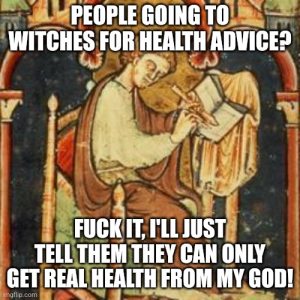
In On Auguries, Ælfric warns his fellow Christians against consulting witches (wiccan) for divination/prophecy, claiming devils as the reason why their predictions prove true. (According to Ælfric, everything a witch could do was down to devils.) In the same text, he also speaks against going to witches for advice about health, a far more holistic concept at the time which not only pertained to physical health but matters of luck, prosperity, and safety. And more curiously, he rails against Christians making offerings at trees and earth-fast stones for healing “as the witches teach.”

“Evergreen content…yeah.”

You may have already noticed this, but the roles of the early English wiccan as alluded to by Ælfric, are not so different from what we attributed to the seiðkona, Heiðr, in the Völuspá passage quoted toward the beginning of this essay.

Moreover, I would go so far as to say that those roles sound somewhat cultic. Things a priest/ess might do.

And yes, I know everyone decided this particular line of thought was bullshit decades ago. But if you ask me, we threw out the baby with the Margaret Murray bathwater.

The Witches In The Glosses

Moreover, these possible associations between cultus and wiccan are further strengthened by the Aldhelm glosses. These were Old English translations of Latin words added to a manuscript after its production to aid comprehension. This really isn’t so different from modern readers designed for language learners where you have the target language text and a small glossary of the more difficult words at the bottom of the page.

The relevant glosses are found in the Digby MS 146 manuscript and date back to the 11th century. There we find wiccan glossed with words like p(h)itonissam (or “pythoness,” a term that derived from the oracular priestess of Apollo at Delphi), and ariolum (diviner, seer). We also find wiccan cited as a cognate for helrunan, and wiccecræft used as a gloss for necromantia or “necromancy.” A gloss we find repeated in the 12th century manuscript, MS Royal 6.B.VII.

The Meaning In The Witch

Finally, we come to the etymology of “witch.” As I said at the top of this post, our modern word derives from the feminine form of the OE noun, wicce. Beyond that though, a number of possible etymologies have been proposed. The one I cite below is that found in Gus Kroonen’s Etymological Dictionary of Proto-Germanic:

“*wikkōn- w.v. ‘to practice sorcery’ – OE wiccian w.v. ‘id.’, WFri. wikje w.v. ‘to tell the future, warn’, MDu. wicken w.v. ‘to practice sorcery’, MHG wicken w.v. ‘id.’*uik-néh₂- (WEUR).

Derived from the same root as found in *wiha- 1 and *wiha- 2 (q.v.). The verb served as the derivational base for OE wicca m. ‘witch’, wicce f. ‘id.’ < *wikka/ōn- and MHG wicker m. ‘soothsayer’. Also cf. OE wigol adj. ‘prophet ic’ <*wigala- and OE wĭglian, (M) Du. wichelen ‘to practice divination’.

*wiha- 1 adj. ‘holy’ – Go. weihs adj. ‘id.’, OHG wih adj. ‘id.’*uéik-o- (WEUR) – Lat. victima f. ‘sacrificial animal’ < *uik-tm-ehz-. Also cf. Go. weihan w.v. ‘to bless, consecrate’ < *wihen- and ON vígja, OFri. wi(g)a, OS wihian, Du. wijden, OHG wihen, G weihen w.v. ‘id.’ < *wih/gjan-. Related to *wiha-2 and *wikkōn- (q.v.).
*wiha- 2 m./n. ‘sanctuary’ – ON vé n. ‘mansion; sanctuary’, OE weoh, wig m. ‘idol’, OS wih m. ‘temple’ (WEUR). Closely related to *wiha- 1 ‘holy’ (q.v.).”

How interesting that once again we find ourselves back in the realm of cultus!

Final Words

This post has been long and something of a winding road. However, the picture that emerges is surprisingly coherent, spanning a variety of textual sources, and has strong parallels with themes found in later Old Norse material.

I’ve actually been wanting to write this for a while for a couple of reasons. The first is that I’ve found myself getting increasingly frustrated by the perennial discourse surrounding the matter of what a witch is and who gets to call themself a witch. So, I hope this provides some helpful context for these discussions going forward – or at least encourages more precision with regards to the era of witchcraft being discussed.  Secondly, I wanted to highlight the connection between those original wiccan and Heathen cultus, and to begin drawing attention to the parallels in ON accounts of seiðr. For a multitude of reasons (many shitty), the label “witch” has been somewhat stigmatized in modern Heathen communities, something to be avoided, and primarily associated with modern Wicca. I would like for that particular discourse to also shift.

As for whose cultus I think the wiccan might have belonged to? My personal guess would be that of Ing, the early English Freyr, but I’ll have to save my reasoning for that for another post.

For now though, let’s just concentrate on getting that proverbial baby back into the bathtub. Murray’s work may be riddled with issues, but even a stopped clock is right twice a day, and I think there is enough here to conclude she was right that the witch’s roots lie in pre-Christian belief, likely in the realm of cultus.

With that said, be well all!

Oh, and before I forget, I’m giving another class on Sunday. This time I’ll be looking at the matter of luck, what it is, its implications for magic, and how to work with it. Interested? You can find tickets (along with more info) here. All ticket holders receive recordings after the class. This time, the attendee pack is also coming with a little book as well.

Sources

Bouterwek, K. “Die Angelsächsischen Glossen in dem Brüsseler Codex von Aldhelms Schrift De Virginitate.” Digizeitschriften. n.d. https://www.digizeitschriften.de/id/345204107_0009%7Clog30?tify=%7B%22view%22%3A%22info%22%7D

“Caedmon’s Metrical Paraphrase of Parts of the Holy Scriptures in Anglo-Saxon : Caedmon, Benjamin Thorpe : Free Download, Borrow, and Streaming : Internet Archive.” Internet Archive. Accessed September 19, 2024. https://archive.org/details/caedmonsmetrica01thorgoog/page/n265/mode/2up?q=magic

Dronke, Ursula. The Poetic Edda: Volume III Mythological Poems II. 1969.

Elsakkers, M. J. “Reading between the lines: Old Germanic and early Christian views on abortion.” Research Explorer. Accessed September 19, 2024. https://pure.uva.nl/ws/files/1578616/76079_article_08_embargo_twee_jaar.pdf

Hutton, Ronald. The Witch: A History of Fear, from Ancient Times to the Present. New Haven: Yale University Press, 2017.

Jolly, Karen L. Popular Religion in Late Saxon England: Elf Charms in Context. Chapel Hill: UNC Press Books, 2015.

Knapp, R. I. “The Fight Against the Threat of Witchcraft and Paganism in Anglo-Saxon England.” Lux et Fides: A Journal for Undergraduate Christian Scholars 1 (May 2023). https://pillars.taylor.edu/cgi/viewcontent.cgi?article=1001&context=luxetfidesjournal

Kroonen, Guus. Etymological Dictionary of Proto-Germanic. Brill Academic Publishers, 2013.

“Old English Glosses : Chiefly Unpublished : Napier, Arthur S. (Arthur Sampson), 1853-1916 : Free Download, Borrow, and Streaming : Internet Archive.” Internet Archive. Accessed September 19, 2024. https://archive.org/details/oldenglishglosse00napiuoft/page/n1/mode/2up

Pollington, Stephen. Leechcraft: Early English Charms, Plant Lore, and Healing. 2000.

“Pythoness – No, Not a Big Female Snake.” Notre Dame Sites. Last modified October 20, 2017. https://sites.nd.edu/manuscript-studies/2017/10/20/pythoness-no-not-a-big-female-snake

Simpson, D. P. Cassell’s New Compact Latin-English, English-Latin Dictionary. 1971.

Thorpe, Benjamin. The Anglo-Saxon Poems of Beowulf, the Scôp Or Gleeman’s Tale, and the Fight at Finnesburg. With a Literal Translation, Notes, Glossary Etc. by Benjamin Thorpe. 1855.
https://archive.org/details/anglosaxonpoemso00thor/page/12/mode/2up

“Thou Shalt Not Suffer A Witch to Live, A Murderous Mistranslation.” Haaretz | Israel News, the Middle East and the Jewish World – Haaretz.com. Last modified August 17, 2017. https://www.haaretz.com/archaeology/2017-08-17/ty-article/thou-shalt-not-suffer-a-witch-to-live-a-murderous-mistranslation/0000017f-e2c8-d804-ad7f-f3fa49340000)

Vulgate Latin Bible With English Translation. Accessed September 19, 2024. https://vulgate.org/

“Ælfric’s Lives of Saints/17aug – Wikisource, the Free Online Library.” Wikisource, the Free Library. Accessed September 19, 2024. https://en.wikisource.org/wiki/%C3%86lfric%27s_Lives_of_Saints/17aug