The Devil In Me (Giggity)
A while ago now I invited my Facebook friends to “ask me anything.” Sometimes I’ve just got the devil in me and want a bit of chaos to keep me going.

I’ll be honest: I was hoping for unhinged.
I was hoping for the kind of questions that would make me cackle maniacally before spewing out an even more unhinged response.
What I got, however, were a handful of sensible, useful questions. I’m not. complaining, of course. I just wanted to give them some time to marinate in the old brainmeats before I responded. And well, this one’s probably more fermented than anything. It’s been a while, as I said.
The AMA Question That Launched 1000 (ish) Words
The first of the questions (and topic for this post) went as follows:
“What are your fave methods for letting go of real world junk and stress before doing magical work?”
Now I could say something along the lines of “I like to take a ritual bath and do a few minutes of meditation.” But honestly, I’m finding the classics somewhat deficient nowadays. It’s not that they don’t work; it’s just that my view of the overall picture has changed. Nowadays I find myself increasingly aware of the battle of consensus raging in our midst. We are, as the saying goes, in the time of monsters between the old world and new, each faction fighting for its preferred shape.
In my opinion, that “real world junk and stress” is a lot weightier than most might think.
Stories As Spirit-People
If you’ve been reading this blog for a while, you’ve no doubt seen me talk about Story and narrative. After all, it’s something I do a lot. You see, I sincerely believe that some of the stories in the ThisWorld would be better understood as a kind of spirit-person, imbued with their own agency and power of shaping. And as strange that might sound, I’m not alone in that belief, either.
Take, for example, Elizabeth Gilbert of Eat, Pray, Love fame. Her book Big Magic opens with an account of how a story came to her at a time when she couldn’t fully devote herself to its work. Some time later though, she happened to meet up with a fellow writer, who then excitedly described her new book. The plot, it turned out, was almost exactly the same as the one that Gilbert had had to pass up.
When I first read Big Magic, I felt excited. (I also, naturally, spent a bunch of time shouting “That’s Awen!” at the pages, like Gilbert could somehow hear me through the paper.) My own experiences with Story and story-spirits (mentioned here) had already led me to much the same place as Gilbert. But it’s always nice to discover you’re not the only weirdo in the village, so yay!
I suspect the only real difference between Gilbert and myself is our framing. Well…that and the whole “making sigils for protagonists” and “actively channeling their words” parts of it as well. Those bits are probably different.
The Troubles With Story-Spirits
What I’m getting at here is that most people don’t typically think of stories as a kind of people. But what if they were? Regardless of your beliefs on this matter, just imagine for a moment that some of the big stories you know are spirit-people. How would that change your approach to, for example, (Christian) religious baggage or nationalist narratives? What tools might you create or seek out to help with discernment?
Ask any group of Witches or other practitioners what they look for when discerning the influence of a demon, ghost, or fairy, and you’ll get answers for days. (Bonus points for a fight or fights breaking out in the comments!)
Discernment is Witchy 101, right?
But ask that same group a similar question about Story, and you’ll most likely be met with confusion. Some of those same folks might even think you crazy, or confidently inform you that “You can’t feel the influence of a story!”
Well, not with that attitude you won’t!
All differences aside, however, I think we can all agree that stories do have the power to shape. That power plays out in propaganda, marketing, national, and religious narratives each and every day. It’s always been there, but our modern tools have supercharged its capabilities. How many of us nowadays inhabit societies where people experience very different realities?
Even worse, those stories continue to maintain their grip even when proven detrimental to their participating groups or individuals.
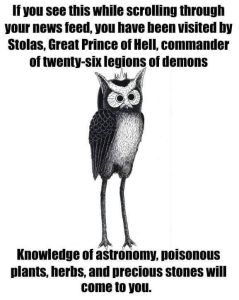
Imagine a demon with the power to enthrall entire nations to the same degree as a religious or national narrative – how fearsome they’d seem!! For all the breathless reporting about the odd demonically influenced murderer, there are stories out there inspiring people to commit whole-ass genocides. Some stories frankly make most demons look like petty bitches. Our society just takes their influence for granted, so most don’t even see it coming.
Anyway, back to my “fave methods of letting go of real world stress and junk before doing magical work.”
The Story-Spirits And Games At The AMA’s End
My current approach is to do the classics (purification, grounding/centering/shielding, and meditation). But I’m also well aware that stories aren’t so easily banished. How often have you done all of the above only to later catch old narratives creeping into your mind while working? As I blogged about here, our minds not only run on story, the stories within us shape our entire perception of reality.
All of which leads me to roleplaying games (RPGs).
Ordinarily we tend to think of RPGs as separate from magic. However, as the academic Sarah Lynn Bowman makes clear in her book, The Functions of Roleplaying Games, RPGs have clear ritual elements and may even fulfill the need for community ritual for some participants. Once upon a time, I tried to solve this issue by creating an alternate persona for ritual and magic via self-hypnosis (terrible idea, by the way). But what about creating an aspirational character as a way of sidestepping the stories currently shaping me for a glimpse outside their box? Though often overlooked, play can be powerful – a disarmingly liminal Fool-space full of potential. Some of my best channeling sessions with my ancestors have come because I decided to “just pretend” I was doing it, and in so doing, got out of my own way.
So, why not choose to embody the story I want until those other stories (hopefully) lose their grip? After all, I’m “just” playing, right?

 the availability of books and tools we have now), would have been unimaginable.
 We get attached to possessions, and to make matters worse (?), we live in a society in which we’re constantly told that we need to have the right product in order to fix whatever it is that is wrong/fill that hole/make life perfect.
 mindfulness and discipline, form a chunk of the core of our training.