

Somehow I missed the usual social media ruckus around St Patrick’s Day this year. I’m not entirely sure how, as it wasn’t intentional. But somehow I did.
(Algorithms. It was probably the algorithms.)
A week-or-so later though, my feed was full of it. All the same arguments, all the same misconceptions recycled from year-to-year. And of course, I also saw the same people valiantly wading in to stem the tide of bad information.
You know, the usual story.
Arguing about this stuff seems to have become something of a tradition nowadays, and an unwanted one at that. Once upon a time, I would have been out there as well, but nowadays I’m just glad to have missed the whole thing. (If only the same were true for Ostara!)
You see, one thing I’ve realized over the years is that these arguments really aren’t about the topic at hand for the most part. In my experience, they’re usually about something much deeper. And until we address that something, no amount of good information is going to turn back that tide.
Conversion
As I explained in this previous post, facts and logic do poorly against narrative. Unlike data, story is an immersive experience that speaks to both the heart and the mind. A well-crafted story can summon tears and devastation, affection or hatred for protagonists, exultation and joy. But if we’re not careful, a story can become bandaid for whatever bits of brokenness or lack we perceive in our lives and selves. Other times, stories can function as narrative bridges between our areas of perceived lack and what we think we need to feel whole. I have no way to prove this, of course. But I suspect that this is what underlies much of the modern Pagan/Heathen tendency to cling to inaccurate narratives.
Nowadays, religious conversion is mostly thought of as a ritual. Depending on the faith or denomination in question, there may be some training beforehand. But even in those instances, it’s still the ritual that makes the convert. A few words and a Jesus-powered supersoaker to the face (or whatever), and boom, you’re saved!
Sounds simple, right?
If only! Unfortunately, that blessed bukkake is really just the beginning of a constant and unending process. Real talk, but pretty much none of us—even those of us who’ve been doing this for decades—will develop a truly Pagan/Heathen worldview within our own lifetimes. That’s not just me being negative, it’s the truth. In this case though, I think it’s pretty freeing.
Believe it or not, but it took the early English church centuries to fully stamp out the Heathen worldview among their people. Conversion wasn’t just a case of some monks rolling up, selling people some Jesus, and everything falling into place. Christianity was largely an alien worldview to them. All of which meant the church first had to build entire conceptual frameworks to fully transition their flocks to their new faith.
So, why would we expect it to be any different for us now? If anything, I would argue our path is much harder after a millennia-and-a-half of Christianity shaping our cultural default. (And yes, that includes the parts we consider “secular” as well.)
Conversion: Hard Mode
Those aforementioned challenges aside though, the early English church had something we don’t—something that gave them a serious advantage.
They had the support of a religious institution with at least a few centuries already under its belt.

It’s never easy stepping onto a new path, but it’s much harder when that path is either doesn’t exist or is mostly buried under dirt. There’s a saying that the difference between dialect and language is an army and navy. I think we can apply a similar framework here too.
So, what is the difference between a religion with roots and whatever “dialect” we have? Well, fully developed systems of support and institutional control, for a start. Clear boundaries that—yes, contain—but also comfort and convey a feeling of certainty to those on the inside.
A Catholic (for example) never has to worry about whether they’re “doing it right” or the veracity of a saint’s hagiography. Not only do they have religious training in the form of catechism classes, they have various flavors of clergy to guide them as well. Their religion boasts entire toolboxes of responses to the uncertainties of life. Set prayers and rituals, a constellation of saints for whatever the need, and the many benefits that come with a somatic practice like praying with beads. Finally, they have the comfort of belonging to a tradition that stretches through time, and the sense of security that can bring. (#NotAllCatholics)
And as long as they stay within the boundaries delineated by their church, they never need to worry they’re doing it wrong, or whether what they’re doing is even <em>real</em>. And why would they? The Roman church is old as shit. And as we all know (heavy sarcasm here) age always confers legitimacy.
Now, consider our own traditions, practices, and communities for a moment—our various toolboxes for this journey through life. What do we have, and what do we lack? All things considered, I think it’s hardly surprising that so many of us cling to false narratives and dream up links to ancient traditions. Belonging, security, and connection are after all core human needs.
Walking A Path With No Path
Another story now.
I’m old enough to remember when Triumph of the Moon by Professor Ronald Hutton made its way into the world. I’ve never been Wiccan in the modern sense (the OG definition though, is another matter). But I can only imagine how it must have felt for those who were at the time. Here was this scholar disproving the foundational lore of their tradition—lore that had no doubt gave many of them that sense of belonging and connection to older roots. (With all the security and legitimacy that apparently implies).
I could go on about the downstream effects of this shift, but that would be one hell of a digression. More to the point though, it would also likely lead back to arguments surrounding historicity and legitimacy when I think we’d really be better off looking for the proof in the pudding instead.

You probably already know the old saying that “The proof of the pudding is in the eating.” Simply put, you have to try something to know its flavor or worth. Is it good? Bad? Does it belong in the bin, or can it be saved? This is what I’ll be referring to as “pudding proof,” from here on out.
Now obviously, Hutton’s Triumph of the Moon didn’t break Wicca. Like I said, I’ve never been that kind of Wiccan myself, but I suspect there was enough pudding-proof to sustain the tradition regardless. In other words, the pudding proved good enough in the eating to keep making it.
Hooray for that Wicca-pud!
But what do I mean by “pudding” in this context? Well, it’s your rituals, workings, and practices. But more importantly, it’s the results and experiences you get from them.
Sir, Your Pudding Is Lacking!
Now, that may sound like “hopium,” but really it’s not. Once upon a time, even the Roman church was new. Their path wasn’t just wrecked or hidden, they were cutting it as they went. Christianity was far from the “full-service” religion it is now.
The Pagan shrines and temples on the other hand were community hubs, offering services like healing, oracular wisdom, dream incubation, and divination by lots. They were places of poetry and music, drama and dance, art, sculpture, and rhetoric (MacCullen, p. 150-159).
So you know, pretty neat places to hang out.
The cults the early Christians left had centuries-old rituals, entire languages of symbolism and ritual gestures. They had play, dance, and celebration—all of which were missing from the new Christian faith.
Hell, they weren’t even supposed to light candles in their churches unless they needed light!
“We do not light candles, as you vainly and untruly allege, in the daytime but only to lessen the darkness of the light. And bear in mind that we are not born Christians, but reborn: and because we once worshipped idols, are we now not to worship God? —lest we appear to venerate him with the same honors accorded to idols?”
Jerome to Vigilantius, 4th/5th century (MacCullen. P. 116)
Even something as foundational as prayer was an unknown language to them. They knew how to address the older divinities through speech, song, sacrifice, and dance, but their new god was entirely another matter (MacCullen. 150-159). The line between piety and idolatry was still taking shape.
But do you see what I mean? The early Christians were once where we are now (albeit traveling in the opposite direction). They, too, felt gaps in their new faith—areas of lack that sent many-a-convert back to their local Kalends and New Year’s celebrations (Ibid).
The question now then is what kept them on their new path? Obviously, the threat of persecution would come to play its part, as would the eventual transition to a “full-service” religion. But what about for those who were Christian before they won an emperor to their faith?
On Pudding Proof
Well, this is where that “pudding proof” I mentioned earlier comes in.
Again much like us, the early Christians couldn’t exactly make appeals to history or tradition. They would have been sitting on a throne of lies and they knew it. So how does a religious new kid on the block attract converts and keep them?
They focus on who is right, on whose god is a true god as opposed to a demon.
In other words, the early Christian case for conversion hinged on proving their “pudding” was good (MacCullen. p.11-12).
The Demon In The Martyr’s Pudding
According to Peter Dendle in Demon Possession In Anglo-Saxon England, exorcism was one of the main “selling points of early Christian evangelism.” Yup, much like today, turfing out demons was one of their main (if not the) kinds of pudding. A point the 2nd century bishop Irenaeus also acknowledged (Dendle. p. 54).
Now curiously, tales of demonic possession and exorcism are arguably absent from in Greco-Roman sources prior to the first and second centuries (Dendle. pp.52-53). That’s not to say that there weren’t any, of course. But the earlier references that do possibly exist are hotly debated by scholars.
The first clear example of possession and exorcism in Pagan literature appears in a 2nd century account of a Syrian exorcist from Palestine, suggesting these beliefs had their origin in the near east (Ibid). That may seem a leap until we consider the writings of the second century philosopher Plutarch. Not only did he feel the need to interrogate the origins of such beliefs, implying a lack of familiarity with them on his part, he presumed a non-Greek origin from the start (Ibid).
Weird, that!
It kind of reminds me of how the possession and exorcism narratives in early English sources were all written between the 670s and early 700s (Dendle. p.170). Though there are some later mentions, they are only ever in passing—usually while referring to a saint. A far cry from the dramatic tales of those earlier times. I’m sure that Pagan resurgence post the plague of 664 was also just a coincidence—just like that suppression campaign by the Christian kings beginning around 650 (Dendle. Pp. 146-148). Probably all just coincidence.
Right? All I’m saying is it just seems a bit convenient, you know?
Well anyway, back to those early Greco-Roman Christians. You see, not only were they slinging this (probably) new-to-their-target-audience kind of “pudding.” They marketed themselves as the best demon-pudding slingers to boot. According to the second century martyr known as Justin, Christian exorcism was the only kind that always worked—even when the possessed person was a Pagan. While he conceded that exorcisms done in the name of Abraham/Isaac/Jacob/God might sometimes work, only those done in Jesus’ name were certain of success (Dendle. p. 54).
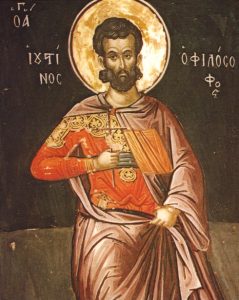
The demon, the mark, and the audacity of that zealot, amirite?
Ironically, Justin went on to literally lose his head for the crime of impiety. As someone who refused to offer to the gods, he was considered an atheist. After all, that Pax Deorum (“peace of the gods”) wasn’t going to do a Pax Romana (“peace of Rome”) without some offerings greasing the wheels (Kirsch. pp. 108-109). From the perspective of Roman society, the dude was falling short of his civic duty, so it was off to the forever box with him. (Click here for an account of his trial.)
“Oh, miserable men! If you wish to die, you have precipices or halters.”
–Roman proconsul stuck dealing with people like Justin.
Sourcing, Tweaking, And Tossing Pagan Pudding
But what about our Pagan Pudding? We already have quite a lot (some of it actually good), but something tells me the recipe isn’t quite there for a lot of us. So, what now?
Nowadays, we have an entire genre of horror linking Christianity with possession and exorcism narratives. The early Christians though, were far from the first demonologists. People in the ancient near east had been casting out demons for millennia before the advent of Christianity. I mean, the ritual technology of exorcism was first attested in Sumer from around 2500 BCE (Dendle. P. 42). Borrowing has long been a source of “pudding,” and frankly the same can be said for just making shit up. How many of those early exorcism narratives do you think were true, and how many were bullshit? Given the convenient dating of those narratives, I’d say the answer to the latter part of that question was “a lot.”
Having said that, there can be a fine line between invention and inspiration, especially when we walk that line in a playful manner. Play often makes doorways for true inspiration where it would otherwise struggle to slip in. We should lean into it! It also needs to be said that there’s nothing inherently wrong with outright making shit up either. Read up on basic ritual structure and magic, and you can make some really excellent pudding! We just need to be honest about what we’re doing.
For me personally though, the rubber really meets the road when working in collaboration with the Dead, Divine, and Otherworldly. Over the years, I’ve been lucky to have teachers in each group and have received some absolute gold from all three. Pretty much all of my experimentation revolves around inviting that collaboration, deepening those connections, and finding ways to intensify my experiences. I may jokingly refer to it as “magical FAFO”, but in truth, it’s the work of relationship and revival. A sacred thing.
No matter the source of our “pudding,” however, we do have to actually give it a try once made. This may seem obvious, but since becoming an author, I’ve had more than a few folks express genuine surprise that I test everything I put out into the world. So clearly, the expectation of testing isn’t universal when it really should be.
Another important point: we need to be honest about our results, even if only to ourselves. Here I’m reminded of the saying that “tradition is not the adoration of ashes, but the preservation of fire.” Now, this may just be me, but I feel like a lot of us have piles of ashes we should really toss out. And yes, that does also apply to the practices and rituals we perceive to be more historically accurate (ergo “legitimate”) too. If it ain’t working, it ain’t working. Sometimes we may tweak and find an ember to kindle; other times though, they’re just plain dead. (Assuming they even worked in the first place.) Either way, we need to be clear-sighted about what we have and to act accordingly. All these piles of dead ashes do for us in the end is waste our time and take up space.
Perceptions Of Worship
Equally important to consider is how our former religions have shaped and continue to shape our understanding of worship, for that, too, influences the pudding we make. For the Pagan of Rome “joy was worship,” to quote Ramsey MacMullen. ”At the Kalends or Attis day as at Easter, it was an offering of faith to show one’s happiness” (MacMullen. p. 109).
Now ask yourself, when was the last time you felt true joy in your worship? What about love? When was the last time you sang to your Holies, danced, played an instrument in their honor, or engaged in sacred play? More importantly, how do you feel when you think about those things?
What feels “allowed” or “proper” to you within the context of worship, and what feels “taboo”?
Because I suspect a lot of us are still closing ourselves off to some degree, perhaps giving ourselves over to instinct and inspiration only rarely. While I believe my holy powers are patient and fully understand that humans now are not as they once were, I also often find myself wondering whether we can truly worship any divinity with a heart half-caged by the “Thou shalt nots” of another faith. And the whole thing just makes me feel so sad for us all, you know?
In many ways, we’re just like those early Christians with no idea how to pray, and no real systems of support. But unlike them, we also have to contend with the added challenge of materialism as well. That, too, has shaped our modern consensus. In some ways, the line between “acceptable” modes of worship and “THESE PEOPLE ARE FUCKING CRINGE/INSANE/WEIRDOS” has never been finer. And the upshot of this? Well, how often do we see aesthetic put before devotion? In other words, often people worry more about how a ritual or practice looks than what it actually does.
Final Words
Believe it or not, I didn’t write this to make you feel hopeless—quite the opposite! Our paths may currently suit goats better than humans, but that doesn’t make them impossible. No, I wrote this because there is a way forward. We just have to lean into the doing—eat that pudding and keep tweaking until it’s actually good.
Simply put, our rituals and practices need to connect us to something bigger, however that looks for us. If we’re going to survive, we need pudding that’s good eating, and lots of it. Oh, and our spells need to get the goods as well.
Because at the end of the day, it’s experience and relationship that really grow and sustain a faith. So, the sooner we stop looking to history for legitimacy, the better. Now, don’t get me wrong; I fucking love history and often find it sparks inspiration. But those sparks need feeding, and all our wood is decidedly modern. Moreover, as I said at the beginning, a lot of people also mistake history for a bandaid for lack, which can then leave them susceptible to false histories and fake lore.
Far better to focus more on the doing and see what rolls out. After all, it worked out well for the Christians.
Now, go stuff yourself with pudding. (And I hope it proves good.)
Bon appetit!
Books Cited
Dendle, Peter. Demon Possession In Anglo-Saxon England.
Kirsch, Jonathan. God Against The Gods.
MacCullen, Ramsey. Christianity And Paganism In The Fourth To Eighth Centuries.